Human + AI Collaboration
How Many Agents Can One Person Answer For?
Designing human–AI workflows around the constraint that actually binds.
Executive brief
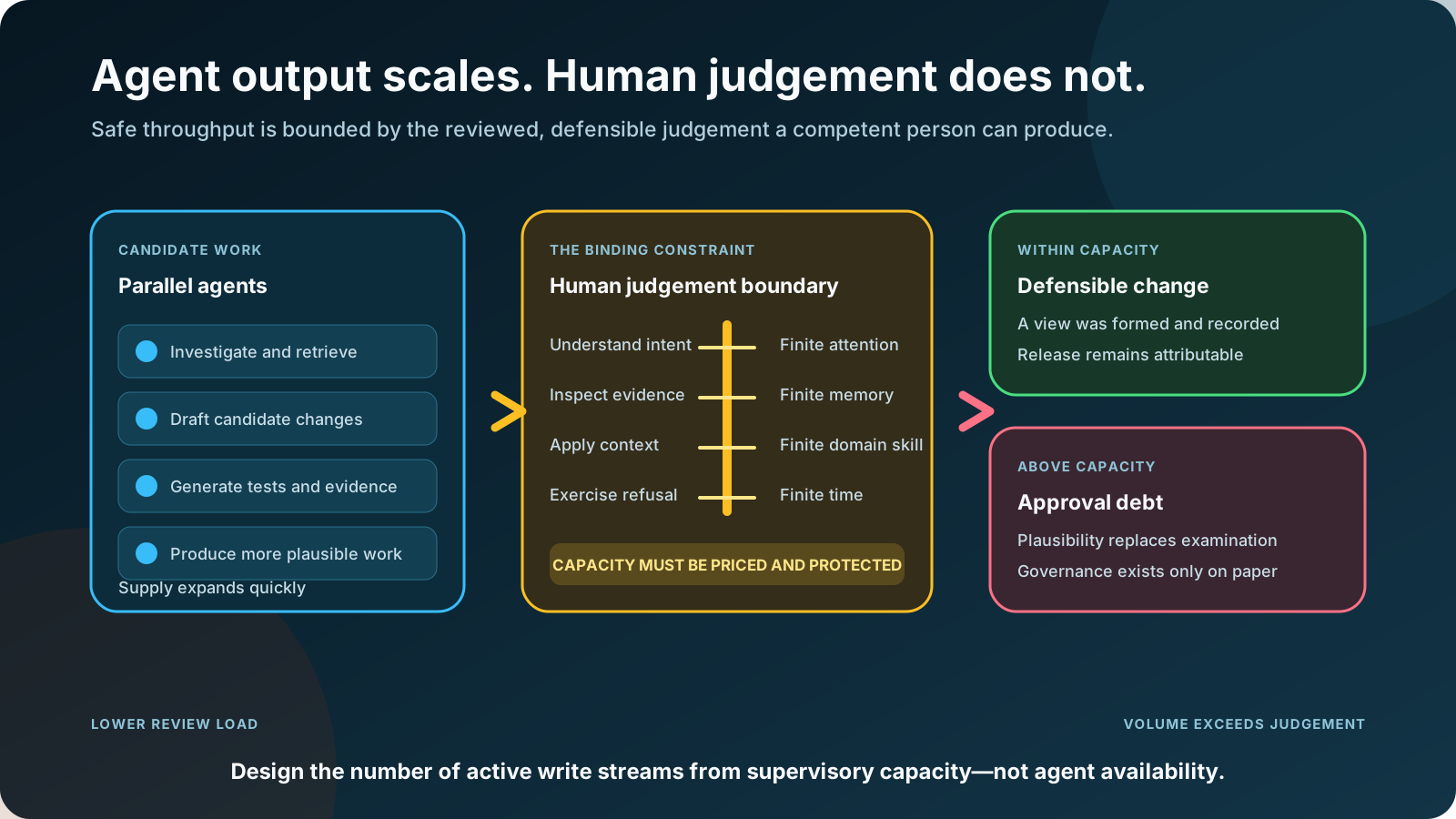
There is no universal human-to-agent ratio. The safe number is derived from the amount of reviewed, defensible judgement a competent person can produce for the specific workload. Read-only research can fan out widely because outputs are independent; concurrent writes into shared or consequential systems need a small, bounded queue, named reviewers with refusal authority, and evidence that a judgement occurred rather than an approval merely being recorded.
Key takeaways
- The scarce unit in agent-assisted delivery is reviewed, defensible human judgement—not generated output.
- A recorded approval does not by itself prove that a competent person formed and evidenced a view.
- Read-only parallelism scales further than concurrent writes because independent findings are easier to reconcile than shared-state changes.
- The safe agent ratio must be derived from consequence, reversibility, coupling, domain ambiguity, batch size, and review time.
- Reviewers need allocated capacity, explicit examination standards, and the right to refuse volume.
- Agents can own candidate production, but accountability for consequential decisions remains with named human roles.
- Rework, review latency, batch size, duplication, and decision-reconstruction drills expose supervision failures earlier than throughput metrics.
TL;DR
Most human–AI workflow design starts from the wrong question. Teams ask how to divide work between people and agents, when the variable that determines whether the arrangement holds is how much reviewed, defensible judgement a competent human can produce in a day.
That capacity is finite, rarely appears in a capacity plan, and degrades under precisely the conditions agent-assisted delivery creates: high volume, plausible presentation, and low visible variance between strong and weak work. Current evidence points in the same direction from several instruments. Candidate output rises faster than organisational delivery; review queues and change sizes grow; and reviewers can react more positively to machine-generated work even when it contains more redundancy.
Accountability has not moved with generation. FINMA says responsibility for decisions cannot be delegated to AI or third parties, while the EU AI Act explicitly requires people overseeing high-risk systems to remain aware of automation bias. Team composition, role design, and RACI are therefore constrained by the supervisory capacity that actually exists. A workflow that exceeds it can look governed while producing little evidence that a substantive judgement occurred.
Key takeaways
- The scarce unit is reviewed, defensible judgement—not generated output, tokens, seats, or pull requests.
- Approval is evidence of a disposition; it is not automatically evidence that someone formed and recorded a view.
- Read-parallel work can scale further than write-parallel work because independent findings are easier to reconcile than simultaneous changes to shared state.
- There is no universal human-to-agent ratio. The ceiling depends on consequence, domain familiarity, change size, reversibility, and the quality of the specification.
- Reviewers need allocated time, explicit standards, and the right to refuse volume; otherwise human oversight is nominal.
- Agents may produce candidate work, but accountability for consequential decisions remains with named human roles.
- Rework, review latency, batch size, duplication, and decision-reconstruction drills reveal more than raw throughput or adoption rates.
The question that does not get answered
The failure mode I have come to watch for in agent-assisted delivery has little to do with whether an agent can complete the task. It appears when someone from the second line, internal audit, or a sceptical platform function asks about a particular production change and wants to know who formed the view that it was safe.
Not who approved it. The approval is normally present, with a name and timestamp, because the tooling enforces that. The harder question is who formed the view: what they examined, what they compared the change against, which uncertainty they accepted, and what would have caused them to say no.
In a healthy engineering organisation that question is inconvenient and answerable. In an organisation that has scaled agent output without scaling supervision, it often produces a reconstruction. The reviewer remembers that tests passed and the diff looked clean. What the record cannot show is whether a judgement occurred rather than a disposition.
The gap between an approval and a judgement is almost invisible on a delivery dashboard and large enough to matter to a supervisor. It is also the real subject of human–AI workflow design. The fashionable vocabulary is team topology, orchestration, and ideal ratios. The underlying problem is the throughput of accountable human attention.
What the measurements are converging on
The broadest evidence is the February 2026 NBER survey of nearly six thousand senior executives across the United States, United Kingdom, Germany, and Australia. Sixty-nine percent of firms reported active AI use. More than two-thirds of executives used AI themselves, averaging roughly 1.5 hours a week. About nine in ten reported no effect on employment or productivity at their own firm over the preceding three years, while expecting meaningful gains over the next three. This is reported perception rather than direct output measurement, and firm-level productivity is too blunt to isolate one engineering function. It nevertheless shows that adoption is visible before realised enterprise impact is.
Closer to the engineering floor, DX tracked AI adoption and PR throughput across more than four hundred companies from November 2024 to February 2026. AI adoption increased by 65 percent while median PR throughput increased by about 8 percent. DX combines platform telemetry with developer interviews and uses a proprietary throughput measure, so its result should not be mistaken for a controlled causal estimate. The useful signal is the shape: rapid adoption accompanied by a much smaller change in reviewable, merged work.
Faros AI reports the same shape with sharper edges in telemetry from more than ten thousand developers across 1,255 teams. High-adoption teams completed more tasks and merged more pull requests, while review time rose 91 percent, average change size rose 154 percent, and organisational DORA metrics showed no measurable improvement. Faros is a vendor with an instrumentation product to sell, so the figures deserve that caveat. Their value is that they are directionally consistent with evidence produced through different methods.
DORA's 2025 research, based on nearly five thousand technology professionals, provides the strongest framing: AI amplifies the system of work around it. Teams with clear ownership, healthy internal data, small batches, fast feedback, and strong internal platforms can convert individual acceleration into better outcomes. Teams without those foundations produce their existing dysfunction faster.
These findings do not describe a technology that failed to work. They describe technology that reliably increases the supply of candidate work while leaving the organisation's capacity to accept, integrate, and remain accountable for that work much closer to where it was.
The cost nobody put in the plan
Review capacity did not become important because agents arrived. It was always a constraint on how much change an organisation could safely absorb. For decades, authorship and verification remained loosely coupled because both were performed by people at comparable speeds. Supervision arrived partly bundled with production.
That bundle has dissolved. Generation has become partially decoupled from verification, while organisational accounting has not caught up. Teams are sized on delivery capacity. Agent programmes are procured through seats and usage. Capacity plans rarely contain a line for hours of defensible judgement available per week.
The quantity that determines whether the arrangement produces governed output is therefore consumed without being priced. When it runs out, nothing necessarily fails immediately. Pipelines stay green. Approval counts rise. The failure appears later, when the organisation cannot reconstruct the basis for a decision.
The reviewer's blind spot
A 2026 study, More Code, Less Reuse, examined objective characteristics of agent-generated pull requests and the sentiment reviewers expressed toward them. The researchers found that LLM agents frequently missed reuse opportunities and produced more redundant code than human contributors. At the same time, reviewer reactions to the agent-generated contributions were more neutral or positive.
That result does not prove reviewers spent less time or consciously relaxed their standards. It does show a dangerous mismatch between measured code characteristics and expressed response. Locally clean presentation—consistent naming, plausible structure, sensible formatting—can conceal the defect class that architectural review is supposed to detect. The debt is quiet because it does not resemble the defects reviewers were trained to notice at diff level.
The volume context matters. GitHub reported in May 2026 that Copilot code review had processed more than sixty million reviews, growing tenfold in under a year, and that more than one in five reviews on GitHub involved an agent. Human review is not encountering this problem at experimental scale.
The lesson is not that humans are unreliable and should be removed. It is that a human signature is not a sufficient control. Oversight has to be designed around the ways automation changes attention: smaller changes, explicit invariants, independent evidence, meaningful rejection authority, and enough time to trace the critical path.
An old finding that has become load-bearing
Lisanne Bainbridge described the underlying problem in Ironies of Automation in 1983. Automating the routine parts of a task while leaving the human responsible for exceptional conditions creates a predictable tension. Monitoring is a weak fit for sustained human attention. The skills needed to intervene can decay while automation works, then become essential exactly when it fails.
Later human-factors research strengthened the point. Parasuraman and Riley distinguished automation use from misuse, disuse, and abuse. Parasuraman and Manzey reviewed evidence that complacency and automation bias can affect novices and experts, produce omission and commission errors, and resist correction through simple instruction alone.
The EU AI Act now carries this human-factors finding into law. Article 14 requires high-risk systems to enable assigned overseers to understand capabilities and limitations, monitor operation, interpret outputs, disregard or reverse them, intervene, and remain aware of the tendency to over-rely on automated output. The Act names that tendency: automation bias.
Timing matters. Article 4's AI-literacy duty has applied since February 2025, with supervision and enforcement beginning in August 2026. As of this article's publication on 28 June 2026, the political agreement on the Digital Omnibus proposed moving high-risk obligations for stand-alone Annex III systems to 2 December 2027 and product-embedded systems to August 2028; final Council adoption was still pending. The practical point was already clear: the literacy obligation was live while the detailed high-risk oversight duties were moving later.
How many agents, and why the number is derived
The ideal ratio has no responsible universal answer because two inputs vary with the work.
The first is technical coupling. In June 2025, Cognition argued against multi-agent architectures for production coding while Anthropic described strong results from parallel sub-agents in research. These positions were not actually contradictory. Anthropic's system decomposed breadth-first investigation into independent searches and returned compressed findings to an orchestrator. Its own account warned that coding usually contains fewer genuinely independent tasks and more shared context and dependencies.
Parallelism works well when agents are reading, retrieving, comparing, and summarising because outputs can remain independent and reconciliation is relatively cheap. It is much riskier when agents write concurrently into shared state. Each write carries implicit decisions about interpretation, style, edge cases, interfaces, and invariants. Reconciliation becomes the work.
The useful design rule is therefore to preserve one continuous orchestration context, fan out freely for bounded read-only investigation, and keep concurrent writes narrow, isolated, and explicitly integrated.
The second input is supervisory. Anthropic's 2026 agentic-coding report describes engineers using AI across a large share of their work while fully delegating only a small fraction. The gap is the human participation required to specify, direct, check, and integrate. The more unfamiliar the domain, consequential the decision, or difficult the rollback, the greater that participation has to be.
The ratio should therefore be calculated from a review budget:
- Classify the work by consequence, reversibility, coupling, and domain ambiguity.
- Estimate the time required for a competent reviewer to understand intent, inspect evidence, test critical assumptions, and record a view.
- Limit work in progress so that the review queue cannot exceed that budget.
- Reduce batch size or agent concurrency when review latency or rework rises.
- Treat any residual number as a local operating limit, not an industry benchmark.
For independent research, that limit may be relatively high. For several concurrent changes to a regulated production estate, the honest number may be very small. The correct question is not how many agents a person can launch. It is how many consequential outputs they can still explain afterwards.
There is also compounding arithmetic. A chain of five steps, each succeeding independently 95 percent of the time, succeeds end to end only about 77 percent of the time. Adding stages in the name of autonomy reduces system reliability unless the stages are independently verified. That verification returns the design to the supervisory constraint it was trying to escape.
The three functions that must exist
Once composition is derived from supervisory capacity, three functions become unavoidable, whatever names the organisation gives them.
Specification
Someone has to convert intent into a durable form that an agent can execute against and a reviewer can check against. Acceptance criteria stop being planning residue and become part of the control surface. Ambiguity that a domain-aware developer once resolved implicitly can now propagate into generated work at speed.
Review of record
Review cannot remain a rotating obligation assigned to whoever appears free. Consequential work needs a named reviewer of record, allocated time, explicit standards for what constitutes examination, and the right to refuse volume. A reviewer who cannot decline work is not controlling the queue. Small batches become a supervisory necessity because change size strongly affects whether meaningful examination is possible.
Integration
Agent-generated work tends toward local completion. Someone must retain the architectural view across changes: reuse, interfaces, operational history, cross-team assumptions, and the costs that no single ticket owns. This is not a novel AI role. It is the integrating work of a strong technical lead, made more important by faster candidate production.
All three depend on competence. If reviewers learned the domain by building systems and the organisation stops producing people who learn that way, review capacity becomes a depreciating asset. Maintaining it may require routing some work through humans that an agent could complete faster—not as nostalgia, but as deliberate practice for future judgement.
RACI when accountability cannot move to the system
FINMA's position is direct: responsibility for decisions cannot be delegated to AI or third parties. Its 2024 guidance also expects defined responsibilities for development, implementation, monitoring, and use; risk classification; testing; documentation; training; and independent review for material applications.
The UK reaches a similar operating conclusion through existing accountability frameworks. The FCA says its rules emphasise senior-manager accountability and are relevant to safe AI use. Delegation within the Senior Managers and Certification Regime does not remove the accountable person's duty to oversee what was delegated.
A workable allocation looks like this:
- Produce the candidate change: the agent may be responsible; the engineer is consulted; the named human owner remains accountable.
- Specify intent and acceptance criteria: the engineer is responsible; the agent and reviewer may contribute; the named human owner remains accountable.
- Examine the change against the specification: the reviewer of record is responsible; the engineer and agent may supply evidence; the named human owner remains accountable.
- Decide to release: the named human owner is responsible and accountable, informed by the engineer and reviewer.
- Escalate an anomaly: the engineer and reviewer are responsible for human escalation; the agent may provide a signal but is not the control.
- Maintain evidence of judgement: the reviewer of record is responsible for the record; the named human owner remains accountable for its adequacy.
Agents are responsible only where the output is a candidate, never where accountability itself is assigned. Humans retain escalation because an uncertain system and a confident system can present output in the same polished register. A governance model that depends on reliable machine self-report has a gap at the point of greatest consequence.
The Bank of England's 2026 industry roundtables exposed the harder problem. Participants said traditional model-risk validation would not remain sustainable unchanged as generative and agentic systems proliferate, and challenged conventional human-in-the-loop assumptions. The interim response should be consequence tiering: full examination where failure would be materially harmful or difficult to reverse, narrower or sampled review where evidence supports it, and a documented rationale for the boundary.
Enablement is not a general awareness course
AI literacy becomes operational when it is proportionate to the role and the failure modes that role must catch. A reviewer of agent-generated changes in a consequential system needs to understand redundancy, surface plausibility, uncertain output presented confidently, context loss, and the difference between test generation and independent verification. Someone using an assistant to draft routine internal text needs a different standard.
The relevant question is not whether staff completed the same AI-awareness module. It is whether the person assigned to a control can recognise the failures that control exists to catch, has practised doing so, and can show the basis for a decision.
What to measure when obvious metrics stop discriminating
Several historic proxies now move for reasons only loosely connected to value. Throughput can rise because generation is cheaper. Test coverage can rise because tests are generated beside the code they test. Documentation volume is almost free. None of these is useless, but none can carry the conclusion alone.
Measures closer to the supervisory layer still discriminate:
- Rework rate: whether accepted work stayed accepted.
- Review latency and its distribution: whether examination is keeping pace or quietly being deferred.
- Change size: whether the batch was small enough to understand.
- Reuse and duplication trends: whether locally plausible work is degrading the shared architecture.
- Substantive review evidence: whether comments, test results, rejected alternatives, and risk decisions show that a view was formed.
- Decision reconstruction time: how long it takes to explain the basis for a specific production decision using existing records.
The last measure is better run as a drill than displayed as a dashboard tile. Select a consequential change, ask who formed the view, and require the evidence without a reconstruction project. Run it before somebody external does.
Closing
The design problem in human–AI workflows is not simply the allocation of tasks between people and systems. It is that the capacity to form and evidence judgement is finite, was rarely budgeted separately when it arrived bundled with authorship, and now determines whether increased output is governed or merely produced.
Everything else follows. Team composition is derived from that capacity. Roles exist to protect it. RACI must leave accountability with people able to discharge it. Enablement maintains the competence supervision depends on. Effectiveness is not the number of agents launched or changes merged, but whether the organisation can still explain how a consequential decision was reached and who formed the view behind it.
Bainbridge identified the pattern in five pages in 1983, when the automation was industrial process control. The systems have changed. The properties on the human side of the interface have not.
Part of the SDOP series on enterprise AI adoption, AI governance, software engineering, platform architecture, and continuous modernization.
References
- NBER: Firm Data on AI — International survey of nearly 6,000 senior executives on AI adoption, use, realised effects, and expected productivity impact.
- DX: AI's impact on engineering velocity is more modest than expected — Longitudinal vendor analysis across 400-plus companies comparing AI adoption growth with median PR-throughput change.
- Faros AI: The AI Productivity Paradox — Vendor telemetry on task completion, merged pull requests, review time, change size, bugs, and organisational delivery metrics.
- Google Cloud: 2025 DORA State of AI-assisted Software Development — Research from nearly 5,000 technology professionals on AI as an amplifier of existing organisational capabilities and constraints.
- More Code, Less Reuse: AI-generated pull requests — Research comparing redundancy in agent- and human-generated pull requests with reviewer sentiment toward those contributions.
- GitHub: Agent pull requests are everywhere — GitHub's May 2026 account of agent involvement in review volume and practical risks in reviewing plausible machine-generated changes.
- Lisanne Bainbridge: Ironies of Automation — Foundational 1983 analysis of the human-performance problems created when automation leaves people responsible for exceptional conditions.
- Parasuraman and Manzey: Complacency and Bias in Human Use of Automation — Review of evidence on automation complacency, automation bias, attention, and omission and commission errors.
- EUR-Lex: Regulation (EU) 2024/1689—the Artificial Intelligence Act — Primary legal text for AI literacy and human oversight, including the explicit requirement to account for automation bias.
- Council of the European Union: AI Act legislative timeline — Official chronology of the May 2026 political agreement and subsequent adoption process for delayed high-risk-system dates.
- Cognition: Don't Build Multi-Agents — Engineering argument about context fragmentation and coordination costs in multi-agent production systems.
- Anthropic: How we built our multi-agent research system — Orchestrator-worker evidence for breadth-first research and the limitations of multi-agent systems for coupled coding tasks.
- Anthropic: 2026 Agentic Coding Trends Report — Vendor research on human participation, delegation, review, direction, and validation in agent-assisted engineering.
- FINMA: Artificial intelligence in the Swiss financial market — Swiss supervisory position that responsibility for decisions cannot be delegated to AI or third parties.
- FINMA Guidance 08/2024: Governance and risk management when using AI — Supervisory expectations for AI inventory, risk classification, responsibilities, testing, documentation, training, and independent review.
- FCA: AI and the FCA—our approach — Official UK position that existing accountability and governance rules for senior managers apply to safe AI use.
- Bank of England: Summary of AI roundtables—February 2026 — Industry evidence on the limits of traditional model validation and conventional human-in-the-loop assumptions for agentic systems.
Author
Géza Kuti is a senior Data and AI executive based in Bülach (ZH), Switzerland, focused on data strategy, enterprise architecture, AI governance, hybrid cloud, and regulated delivery.
Related expertise