Sovereign AI
AI Is Global. Government Data Is Not
Why sovereign AI is becoming the default architecture for public sector and regulated enterprise adoption.
Executive brief
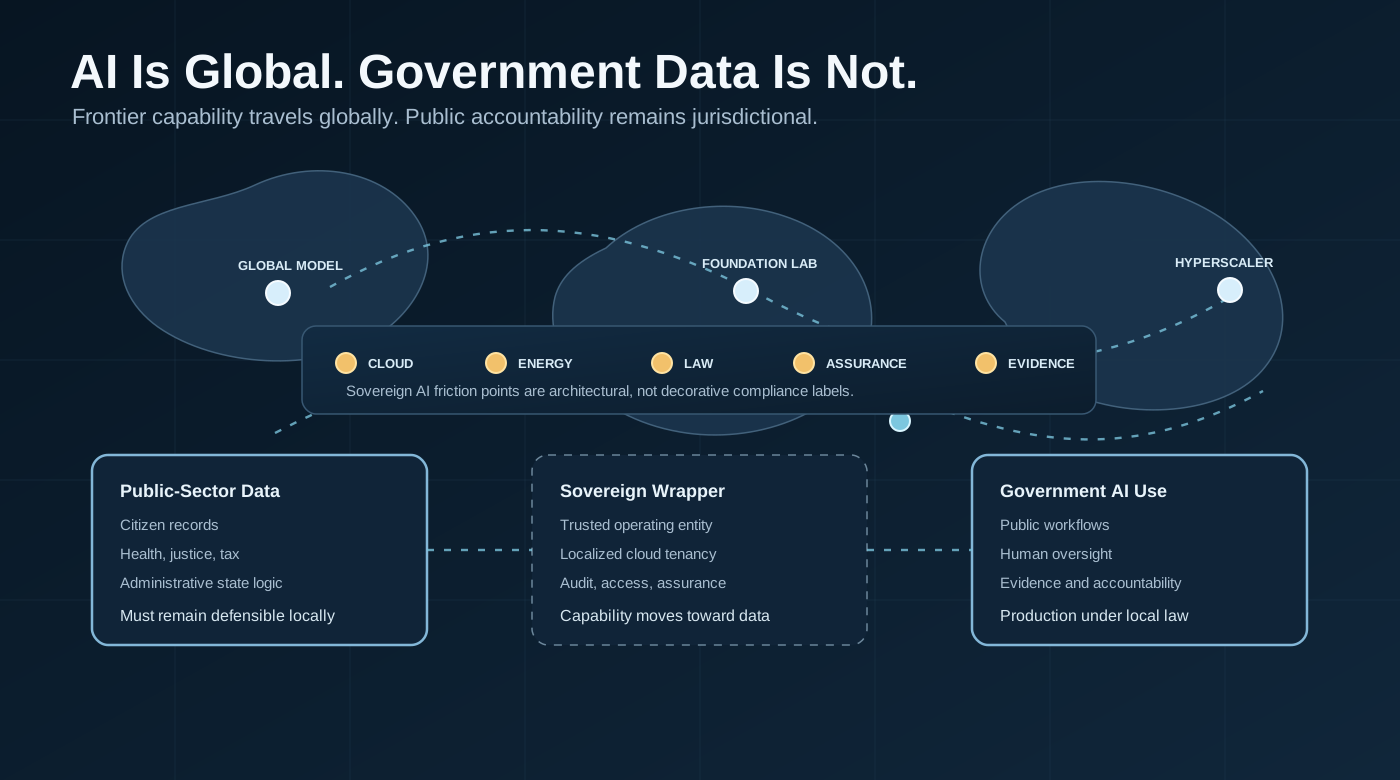
Sovereign AI is becoming a default architecture for governments and regulated enterprises because frontier model capability is global while public accountability, data residency, legal exposure, energy, infrastructure, assurance, procurement, and evidence remain jurisdictional.
Key takeaways
- Public sector AI will be shaped by sovereignty and infrastructure as much as model capability.
- C5, SecNumCloud, and EUCS are architectural constraints, not merely compliance labels.
- The SAP/OpenAI/Microsoft/Delos model shows one path for localized sovereign AI delivery.
- The reported Stargate UK pause shows that AI infrastructure depends on energy, grid access, and legal certainty.
- The countries that succeed may be those that combine compute, sovereignty, energy, and governance into a credible operating model.
Frontier models may be global. Public accountability is still local.
TL;DR
- Public sector leaders want the productivity, analytical, and service-improvement potential of frontier AI, but many cannot simply send citizen, health, justice, tax, defense, or administrative data into global multi-tenant environments.
- The central architecture problem is no longer only whether a model is capable enough. It is whether the model can be delivered inside a jurisdictionally acceptable, operationally secure, and politically defensible environment.
- Schrems II, GDPR enforcement, national cybersecurity baselines, and concerns around extraterritorial legal access have made data sovereignty a design constraint rather than a legal afterthought.
- Frameworks such as Germany's BSI C5 and France's SecNumCloud should be read as architecture requirements. They influence operating model, personnel location, auditability, legal entity structure, cloud tenancy, and supplier selection.
- The SAP, OpenAI, Microsoft, and Delos Cloud partnership in Germany is important because it shows one viable pattern: global AI capability delivered through a legally and operationally localized sovereign cloud wrapper.
- The reported pause around Stargate UK is equally important because it shows the other side of the equation: sovereign AI infrastructure depends on energy economics, grid access, copyright law, capital availability, and national industrial policy.
- The future AI winners in the public sector may not be the countries that invent the best models. They may be the countries that build the most credible sovereign infrastructure for using those models safely.
Opening observation
A recurring tension now sits at the center of public sector AI.
Everyone wants access to the cognitive power of frontier models. Government leaders can see the potential clearly enough: better document processing, faster policy analysis, less administrative duplication, improved citizen service, more effective research support, and a partial answer to the productivity pressures facing public administration.
At the same time, most serious public institutions know that they cannot casually connect sensitive government data to a global model endpoint and call it transformation.
A local authority, ministry, hospital, justice department, tax authority, or defense-adjacent institution does not treat data as a normal enterprise asset. It is citizen data, sovereign data, statutory data, politically sensitive data, or operational knowledge of the state. Even when the legal classification is less dramatic, the accountability boundary remains different from that of a normal commercial productivity tool.
This is the point at which many AI discussions become more serious.
The first conversation is usually about capability. What can the model do? How good is the reasoning? Can it summarize documents? Can it draft decisions? Can it search policy archives? Can it assist caseworkers? Can it automate routine correspondence?
The second conversation is about jurisdiction. Where does the data go? Who operates the infrastructure? Which law applies? Who can access metadata? What happens under a foreign legal request? Is the supplier subject to extraterritorial obligations? Can the institution prove that citizen data remained inside the intended boundary?
In public sector AI, the second conversation often determines whether the first conversation matters.
That is why sovereign AI is becoming the default architecture.
The post-Schrems II operating reality
The European public sector did not arrive at the sovereignty question only because of generative AI. The pressure has been building for years through GDPR, cloud adoption, national cybersecurity requirements, procurement scrutiny, and the long shadow of the Schrems II judgment.
Schrems II is often summarized too narrowly as a legal event concerning transatlantic data transfers. In practical architecture discussions, its effect has been broader. It made public and regulated organizations more aware that the location of data is not the only question. The legal exposure of the provider, the ability of foreign authorities to compel access, the effectiveness of supplementary measures, and the operational reality of cloud service provision all matter.
For public institutions, this changed the tone of cloud adoption. A commercial enterprise may decide that contractual safeguards, encryption, and risk acceptance are sufficient for certain workloads. A ministry, health authority, court system, or critical infrastructure operator often faces a narrower tolerance range. It must consider not only formal compliance but also public legitimacy. A technically defensible architecture may still become politically indefensible if citizens believe that sensitive administrative data is exposed to foreign jurisdiction.
This is one reason the standard SaaS adoption model becomes difficult in government AI.
The commercial SaaS model assumes that software capability can be consumed across borders through globally optimized infrastructure. That model works well for many business applications. It becomes much less straightforward when the workload involves public-sector records, regulated health data, justice workflows, national security-adjacent analysis, or sensitive administrative logic.
In the sovereign AI model, the direction changes.
The data does not travel to the global service.
The capability has to be brought closer to the data.
This is a simple sentence, but it has large architectural consequences. It changes cloud selection, model deployment, support models, contracting, personnel access, auditability, infrastructure investment, and the economics of AI delivery.
Sovereignty frameworks are architecture decisions
One mistake I see repeatedly in enterprise and public sector discussions is treating sovereignty frameworks as compliance badges.
They are not only badges.
They are architecture decisions.
A certification regime such as Germany's BSI C5 or France's SecNumCloud does not merely say that a cloud provider has passed a checklist. It shapes what kind of infrastructure can be used, how it must be operated, who may administer it, how access is controlled, how incidents are handled, what must be auditable, and which legal exposures are acceptable.
That matters because AI is unusually infrastructure-hungry. Traditional government SaaS adoption already had to deal with data residency, identity, logging, encryption, supplier management, and incident response. Generative AI adds localized GPU capacity, model hosting, prompt and output handling, retrieval indexing, embeddings, model updates, evaluation data, and in many cases a more complicated supplier chain.
Germany's C5 catalogue is useful to understand because it represents a disciplined cloud-security assurance model. It is not an AI-specific framework, but it becomes highly relevant when AI workloads are deployed on cloud infrastructure for German public sector or regulated environments. C5 requires a structured cloud assurance approach, typically supported through independent audit mechanisms, and it makes transparency around system description, controls, access, incident management, and data location part of the trust model.
France's SecNumCloud has a different strategic meaning. It is one of the clearest examples of cloud sovereignty being expressed through security qualification, legal independence, European operation, and protection from extraterritorial legal exposure. For sensitive French public-sector and critical infrastructure workloads, SecNumCloud is not just a technical preference. It expresses a national doctrine around trusted cloud.
EUCS, the proposed European cloud certification scheme, shows the difficulty of harmonizing this at European level. The ambition is understandable: Europe needs a common language for cloud assurance. The politics are difficult because sovereignty requirements affect market access, competition, hyperscaler participation, European industrial strategy, and national security posture. The debates around EUCS show that cloud sovereignty is not a purely technical subject. It sits directly at the intersection of technology, law, industrial policy, and geopolitical trust.
For an AI delivery leader, the implication is direct. Once a public sector AI system requires sensitive data, these frameworks are no longer downstream compliance considerations. They must influence the architecture from the start.
The choice is not simply which model to use.
The choice is which jurisdictional operating model can safely host the model.
The German pattern: global model, local wrapper
The SAP, OpenAI, Microsoft, and Delos Cloud partnership in Germany is important because it shows one of the more credible patterns for sovereign AI delivery in the public sector.
The underlying idea is pragmatic. German public institutions want access to leading AI capability, but they need that capability delivered through an infrastructure and operating model aligned with German and European sovereignty expectations. The partnership addresses this by placing OpenAI capability into a German public-sector delivery wrapper through SAP's Delos Cloud, which runs on Microsoft Azure technology but is positioned as a sovereign environment for the German public sector.
This matters architecturally because it separates several concerns that are often confused.
The model capability may originate from a global AI provider. The cloud technology may originate from a global hyperscaler. The public-sector operating environment, however, is localized through a trusted national or European entity with a specific mandate, contractual structure, operational model, and sovereignty posture.
That layered structure is likely to become common.
The reason is straightforward. Few European governments are likely to build frontier foundation models at the speed and cost of the largest global AI labs. At the same time, many public institutions will not accept unconstrained dependence on global APIs for sensitive workloads. Sovereign AI therefore emerges as an integration pattern between global capability and local accountability.
The reported expansion of Delos Cloud capacity to support AI workloads with thousands of GPUs is not a minor implementation detail. It is part of the architecture. Public sector AI at scale requires compute capacity close enough to the jurisdictional and operational boundary to be trusted. Without that capacity, the sovereignty story remains mainly contractual.
This is why the German pattern is worth studying. It does not pretend that sovereignty means technological isolation. It also does not pretend that global AI can be consumed without local controls. It attempts to combine both realities into a workable delivery architecture.
That may be the most realistic path for many European governments.
The UK lesson: sovereign AI needs more than ambition
The reported pause around Stargate UK is useful precisely because it shows the other side of sovereign AI.
The UK has strong AI ambitions, a deep research ecosystem, serious policy attention, and a clear desire to strengthen sovereign AI infrastructure. Stargate UK was presented as a major attempt to create local AI compute capability with OpenAI, NVIDIA, Nscale, and related infrastructure partners. The reported plan involved thousands of GPUs and a broader ambition to support sovereign AI workloads for the UK and regulated sectors.
The important point is that the reported pause was not caused by a lack of AI ambition or a failure of model capability.
It was caused by the physical and legal realities underneath the AI narrative.
AI infrastructure at national scale depends on energy costs, grid access, data centre delivery, capital availability, supply chains, planning, and legal certainty around issues such as copyright and training data. These factors do not look like AI in a product demo. They look like infrastructure policy, industrial economics, and legislative coordination.
That is precisely why they matter.
A country cannot build sovereign AI only through strategy documents and partnership announcements. It needs affordable and reliable power, available grid connections, suitable data centre locations, supply-chain access to accelerators, clear legal rules, credible procurement routes, and a regulatory environment that investors and public institutions can understand.
In normal software delivery, infrastructure is often abstracted away. In sovereign AI, infrastructure becomes visible again.
This is one of the most important shifts in the current market.
For years, the cloud era taught organizations to think of compute as elastic and available. AI at national scale weakens that assumption. GPU capacity, power availability, and jurisdictional cloud architecture become strategic constraints. The abstraction leaks.
The UK case is therefore not only a UK story. It is a warning for every country attempting to turn AI ambition into sovereign capability. The model may be ready. The infrastructure may not be.
Switzerland, France, and the return of national infrastructure
The same pattern appears elsewhere in Europe, although each country expresses it differently.
In Switzerland, Swisscom's cooperation with NVIDIA and its investment into trusted AI infrastructure reflect the same underlying logic. Swiss enterprises and public institutions often have strong reasons to prefer local processing, local storage, and a Swiss operating environment for sensitive workloads. This is particularly relevant in finance, healthcare, public services, and other trust-heavy sectors. The Swiss AI Platform is not only a technology offering. It is a response to a market where customers want AI capability without surrendering control over data location and operational trust.
France shows another version of the pattern through Bleu, the sovereign cloud company created by Capgemini and Orange to provide Microsoft cloud services in a French trusted-cloud model aligned with SecNumCloud expectations. The architectural idea is similar to the German pattern: use globally competitive technology, but deliver it through a national structure that can satisfy public-sector and critical-infrastructure sovereignty requirements.
Recent French movement around health data infrastructure reinforces the same point. Sensitive data platforms are increasingly judged not only by functionality and cost but also by jurisdictional exposure, national control, and resilience against foreign legal access. In health, justice, finance, and public administration, this will increasingly shape platform decisions.
Across Europe, telecommunications providers, national cloud providers, enterprise software firms, and hyperscalers are all adjusting to the same market reality. AI infrastructure is becoming a strategic sector. The winners will not be only those with the best user interface or the strongest model benchmark. They will be those that can combine compute, sovereignty, security, compliance, and operations into a form that public institutions can actually procure and defend.
What this means for enterprise architects
For enterprise architects in government and regulated industries, sovereign AI changes the starting point.
The architecture discussion cannot begin with the model alone.
It has to begin with the data classification, jurisdictional boundary, operating model, and assurance requirement. Only then can the organization sensibly decide whether the workload belongs in a global SaaS tool, a managed enterprise tenant, a sovereign cloud, a national partner cloud, an on-premise or private deployment, or a hybrid pattern.
This sequence matters because reversing it is expensive.
Many organizations first select a tool and later discover that the tool cannot satisfy the required sovereignty or auditability constraints. At that point, the program either stalls, accepts risk, or rebuilds. None of these outcomes is attractive.
A better pattern is to classify AI workloads early.
Some workloads are low-risk productivity use cases. They may be suitable for standard enterprise AI tooling with appropriate controls. Other workloads involve sensitive citizen data, regulated decision support, justice processes, health records, critical infrastructure, or confidential administrative logic. These require a different architecture from the beginning.
The enterprise architect's role is to make those distinctions explicit before procurement momentum takes over.
This is where sovereign AI and SDOP thinking begin to touch. The problem is not only where the model runs. The problem is whether the organization can prove which data was used, which boundary was enforced, which policy applied, which actor had access, and which evidence exists after the fact.
Sovereignty without evidence becomes a trust claim.
Regulated organizations increasingly need more than trust claims.
The new geography of AI
The public AI narrative is still dominated by model capability. Which lab has the strongest reasoning model? Which benchmark moved? Which platform released a better agent framework? Which provider reduced inference cost?
Those questions matter, but they are no longer sufficient for the public sector.
A different map is emerging.
It is a map of energy capacity, grid connections, sovereign cloud regions, national cybersecurity certifications, trusted operating entities, public procurement rules, copyright law, data protection enforcement, and geopolitical alignment.
This is the new geography of artificial intelligence.
In that geography, a model can be globally available and locally unusable. A cloud service can be technically excellent and politically unacceptable. A pilot can work in a sandbox and fail procurement because the operating model is wrong. A country can announce an ambitious AI infrastructure program and discover that energy economics or legal uncertainty determine the timeline more than technology readiness.
This is not a temporary inconvenience. It is likely to be a defining feature of AI adoption in governments and regulated enterprises for years.
What I would do Monday morning
If I were advising a public sector institution or regulated enterprise on sovereign AI, I would start by separating AI use cases into architectural categories rather than functional categories.
The first category would be low-risk productivity use cases where the data is non-sensitive, the output is assistive, and standard enterprise controls may be sufficient.
The second category would be internal but sensitive knowledge work where retrieval, access control, logging, retention, and supplier terms become important.
The third category would be regulated or citizen-impacting workflows where the architecture must be designed around evidence, human oversight, auditability, and jurisdictional constraints from the beginning.
The fourth category would be sovereign or mission-critical workloads where the choice of infrastructure, operating entity, personnel access, legal exposure, and national assurance framework becomes inseparable from the AI design.
This classification would make the rest of the program more honest. It would prevent low-risk use cases from being over-governed and high-risk use cases from being under-architected.
I would then ask a small number of practical questions.
Where does the data reside? Who operates the environment? Which law applies to the provider? What metadata leaves the boundary? Which logs are retained? Can the model be updated without violating the assurance model? Can the institution reconstruct what happened if a citizen, regulator, auditor, or parliament asks?
These are not abstract sovereignty questions. They are delivery questions.
Closing reflection
The first phase of generative AI was dominated by the question of capability.
Could the model write, reason, summarize, code, retrieve, translate, classify, and assist?
The next phase in the public sector will be shaped by a different question.
Can that capability be deployed inside the legal, operational, infrastructural, and political boundaries of the state?
For governments and regulated enterprises, model intelligence is only one part of the adoption equation. Sovereignty, energy, infrastructure, assurance, procurement, evidence, and public accountability are becoming equally important.
This is why sovereign AI is becoming the default architecture.
The future winners may not be the countries that invent the best models. They may be the countries that build the most credible environments for using those models safely.
AI is global.
Government data is not.
References
- European Parliament: The CJEU judgment in the Schrems II case — Overview of the July 2020 Schrems II judgment and its implications for international data transfers.
- BSI: Cloud Computing Compliance Controls Catalogue (C5) — German cloud assurance criteria used to assess cloud service information security.
- ANSSI: Prestataires de services d'informatique en nuage (SecNumCloud) — French SecNumCloud qualification page for trusted cloud service providers.
- ENISA: EUCS Cloud Service Scheme — European Cybersecurity Agency material on the candidate European cloud services certification scheme.
- OpenAI: SAP and OpenAI partner to launch sovereign OpenAI for Germany — Announcement of OpenAI for Germany, supported by SAP's Delos Cloud running on Microsoft Azure technology.
- Nscale: UK AI infrastructure announcement — Original public announcement describing Stargate UK and related sovereign AI infrastructure commitments.
- Computer Weekly: OpenAI pauses Stargate UK — Public reporting on the reported Stargate UK pause and its energy, regulatory, and investment context.
- Swisscom: Swisscom cooperates with NVIDIA — Swisscom announcement about building generative AI full-stack supercomputers in Switzerland with NVIDIA.
- Swisscom: Swiss AI Platform — Swisscom enterprise page describing its Swiss AI Platform and trusted AI infrastructure.
- Capgemini: Commercial launch of Bleu — Capgemini and Orange announcement of Bleu, a trusted cloud platform based on Microsoft technology for French public and regulated needs.
Author
Géza Kuti is a senior Data and AI executive based in Bülach (ZH), Switzerland, focused on data strategy, enterprise architecture, AI governance, hybrid cloud, and regulated delivery.
Related expertise
Related articles
When the Model Became a Critical Dependency
The Fable 5 shutdown showed that frontier models can become externally controlled dependencies for regulated enterprises. That changes how firms should think about sovereignty, portability, concentration risk, and operational resilience.
Why Most Public Sector AI Strategies Fail During Implementation
Most governments now have AI strategies, principles, and playbooks. The harder question is whether they have the delivery machinery to turn those documents into safe production systems.
AI Changes Software Engineering, Part 3: The New Operating Model
Part 3 of the AI software engineering series: why AI adoption becomes an operating-model problem, what the emerging AI engineering stack looks like, and what leaders should ask Monday morning.