AI Governance
Why Most Public Sector AI Strategies Fail During Implementation
The hard part starts after the framework is published.
Executive brief
Public sector AI is now primarily an implementation problem. Governments have produced strategies, frameworks, and playbooks, but many have not yet built the operating machinery required to deliver AI safely at scale.
Key takeaways
- Public sector AI is now primarily an implementation problem.
- Frameworks define acceptable behavior, but delivery turns them into working systems.
- Governments are both regulators and consumers of AI, which creates structural tension.
- AI delivery in public services requires multidisciplinary operating capability.
- The next decade will reward governments with delivery maturity, not only policy maturity.
The hard part of public sector AI starts after the framework is published.
TL;DR
- The international public sector has moved quickly from AI curiosity to AI strategy, but the operational machinery required to deliver AI safely at scale remains immature in many institutions.
- Most governments now understand that AI needs principles, policies, risk classification, transparency, human oversight, and safeguards. Those are necessary, but they are not the same thing as delivery capability.
- Public institutions occupy a difficult position, acting as both regulators of AI and major consumers of it, which creates a tension that private enterprises rarely face in the same form.
- The main implementation gap is no longer the absence of high-level guidance; it is the shortage of delivery structures that translate guidance into use cases, architecture, procurement, security, governance, operating models, and measurable outcomes.
- The UK trajectory is useful because it shows the maturation path clearly: framework, playbook, central digital leadership, AI adoption capability, and an attempt to move from departmental experimentation toward whole-of-government execution.
- In regulated environments, AI implementation requires a delivery profile able to translate policy into architecture, architecture into delivery plans, and delivery plans into governed production systems.
- The next decade of public sector AI will be defined less by which governments publish the most ambitious strategies and more by which governments build the strongest implementation discipline.
Opening observation
A familiar pattern is now appearing across governments and regulated institutions. An AI strategy is published, the language careful and ambitious, speaking about productivity, better public services, responsible innovation, transparency, fairness, human oversight, and public trust. The launch is usually well received, because it lets the institution show that it is neither ignoring AI nor rushing into it blindly. The harder period arrives a year or two later, when the organization typically finds that it has more pilots than production systems, more principles than operating routines, more enthusiasm than architecture, and more governance intent than delivery capacity. The original strategy may still be sound, but moving from policy to production turns out not to be a natural consequence of publishing a framework.
I have seen the same sequence in enterprise environments, particularly in banking and other regulated industries. The first wave of AI discussion is usually about what the technology can do, the second about what the organization is allowed to do, and the third - where the real work begins - about what the organization is actually capable of delivering repeatedly and safely. Public sector institutions move through this sequence under additional pressure, because they are expected to adopt AI to improve productivity and service quality while simultaneously protecting citizens from misuse, discrimination, opacity, security failures, and excessive dependence on private technology providers. In that environment, implementation is not a downstream project-management activity; it is the place where policy, architecture, law, procurement, security, and public accountability meet. This is why many public sector AI strategies fail during implementation. They rarely fail because the principles are wrong. They fail because the institution lacks the operating machinery required to make those principles executable.
Policy is easier than delivery
Most mature governments now understand the policy vocabulary of AI reasonably well. They know they need responsible use, human oversight, data protection, security, fairness, transparency, explainability, and accountability. In Europe, the EU AI Act has formalized risk-based thinking and made classification part of the expected governance language. In the UK, the Generative AI Framework for HM Government, published in early 2024, established a structured set of principles for safe and responsible use, and the AI Playbook that followed in early 2025 broadened the guidance beyond generative AI toward practical use across the wider public sector. This is real progress, and it is also insufficient on its own.
A principle such as "ensure fairness" does not by itself create the technical capability to test for discriminatory outcomes. A requirement for human oversight does not define where oversight sits in a workflow, what the reviewer sees, whether that reviewer has the time and expertise to intervene meaningfully, or how the intervention is recorded. A commitment to transparency does not produce the user-facing explanations, model documentation, and audit trails that can survive operational scrutiny. The gap between principle and practice is where many AI programmes slow down.
In delivery work I have learned to be cautious when an organization says a topic is "covered by governance." Sometimes that means there is a functioning decision structure with clear ownership, working controls, evidence collection, escalation paths, and a release process. More often, especially early in a transformation, it means a document exists and a committee has been named. AI implementation exposes the difference quickly. A department may hold a responsible-AI policy and still struggle to answer the ordinary operational questions that decide whether AI becomes a production capability or remains a set of demonstrations: which use cases are low-risk enough to scale, which require legal review or a data protection impact assessment, which datasets are approved for retrieval, which supplier terms are acceptable, who approves a prompt change, who owns the evaluation set, and who supports the system once it outgrows the pilot team.
The UK example: from framework to operating centre
The UK is a useful case because its public documents show a visible evolution from high-level principle toward implementation machinery. The Generative AI Framework for HM Government mattered as an early step because it gave civil servants a common language for generative AI - its limitations, lawful use, ethics, privacy, security, fairness, transparency, and accountability - and public institutions generally need guardrails before experimentation spreads across departments. The AI Playbook that followed moved the guidance closer to operational use. It was written for civil servants and public sector organizations, including people outside the digital and data profession, and it widened the scope from generative AI to a broader range of AI technologies. That shift matters, because the public sector cannot treat AI as a specialist topic owned only by central digital teams; if AI is going to touch casework, policy analysis, citizen services, procurement, fraud detection, planning, justice administration, or healthcare operations, then non-specialist leaders need practical guidance too.
The January 2025 Blueprint for Modern Digital Government went further, describing a new digital centre of government and a six-point reform plan, and placing AI adoption alongside joined-up services, digital public infrastructure, leadership, cyber resilience, and shared components such as GOV.UK One Login. The significance is not merely organizational. It reflects a recognition that AI delivery depends on the same foundations that have constrained digital government for years: data, identity, service design, funding models, shared infrastructure, leadership capability, and cross-department execution. The accompanying consolidation of digital functions - bringing the Government Digital Service, the Central Digital and Data Office, the Incubator for AI, and other units together within a strengthened centre inside DSIT - is aimed at one of the classic public sector failure modes, in which fragmented departmental experimentation proceeds without common standards, common infrastructure, or common accountability.
Viewed from a delivery perspective this is the right direction, even if it is still early and its effects remain to be demonstrated. Public sector AI cannot scale if every department invents its own governance model, evaluation approach, supplier patterns, data-access rules, and operating model. Some local variation is unavoidable, because public services differ, but without a strong centre the result tends to be duplication, uneven quality, and slow learning. The broader lesson reaches past the UK: governments do not need only AI strategies, they need AI delivery systems.
Governments are both regulators and consumers
Public institutions face a structural tension that most private enterprises do not experience in the same form. They are expected to regulate AI in the public interest while also using AI to improve their own operations, and that dual role changes the implementation problem. When a bank deploys AI, it must satisfy regulators, customers, auditors, shareholders, and internal risk functions. When a government deploys AI, it must satisfy all of those concerns and also preserve democratic legitimacy, because a public sector AI failure is rarely read as only a system failure. It can become a question about fairness, institutional competence, procurement integrity, administrative justice, civil liberties, or political accountability.
This is why the public sector cannot simply import commercial SaaS adoption patterns. A private enterprise may absorb a failed productivity pilot as a cost of experimentation, but a government department using AI in a public service has to weigh citizens who cannot opt out, vulnerable populations, appeal rights, administrative transparency, record-keeping, and the symbolic weight of automated decision support inside state functions. The EU AI Act makes the tension explicit through its risk-based approach: some systems are prohibited because the risk is judged unacceptable, while others are classified as high-risk and carry significant obligations around risk management, data quality, documentation, logging, transparency, human oversight, robustness, cybersecurity, and post-market monitoring. Many public sector use cases fall into sensitive areas the Act treats as high-risk, including access to essential services, justice, migration, education, employment, law enforcement, and critical infrastructure.
For delivery leaders the practical implication is straightforward: use-case selection is not only a value exercise, it is a risk-classification exercise, and that reorders the work. A normal technology programme often begins with business value, feasibility, cost, and roadmap priority. In public sector AI those questions still matter, but they have to be preceded by a careful classification of the use case, because a document-summarization tool for internal policy work is not the same kind of system as one used to rank benefit applications, support sentencing preparation, allocate inspections, identify fraud risk, or guide immigration decisions. If the risk classification arrives late, the programme often discovers - too late - that its architecture, documentation, procurement, auditability, and governance model are insufficient for the system actually being built.
The implementation chasm
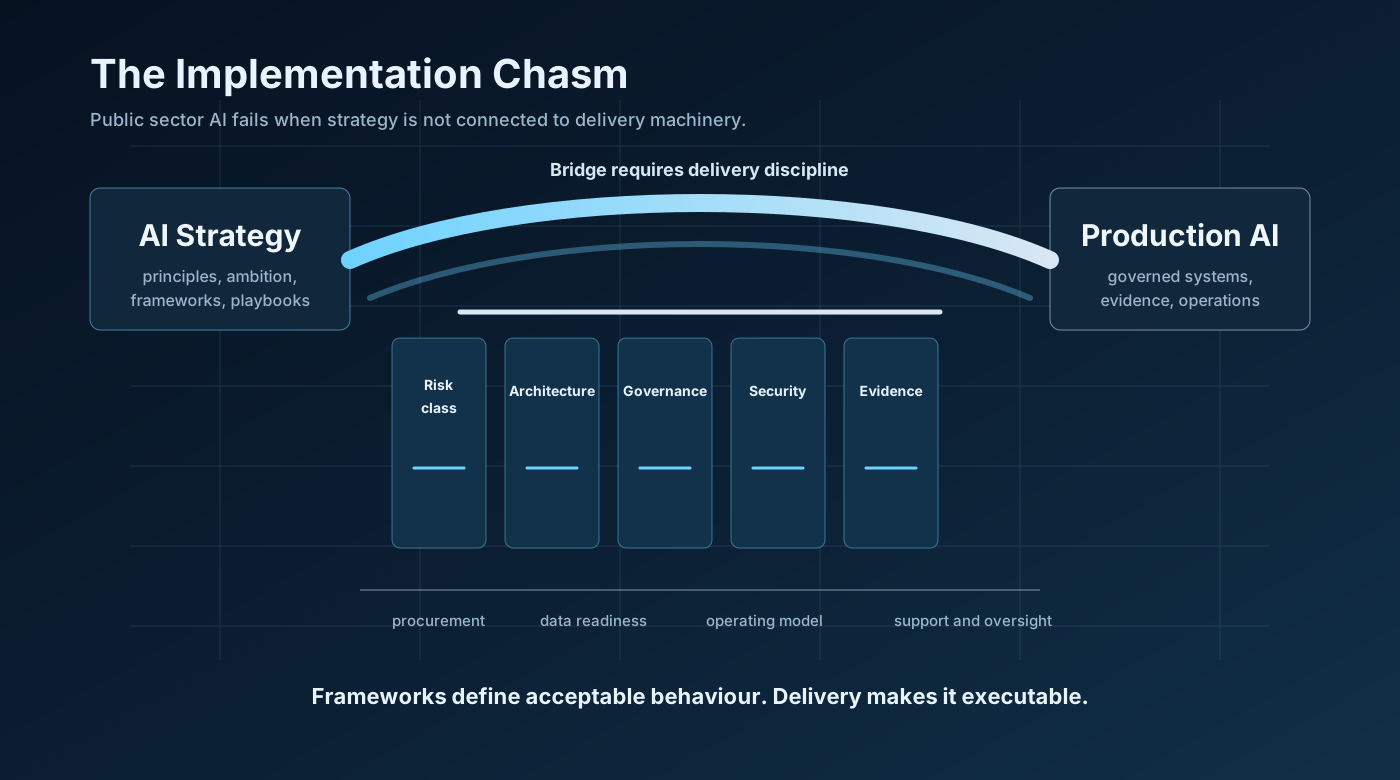
The phrase "implementation gap" is used so often in public sector transformation that it has lost most of its force. In AI the gap deserves a sharper name, because it behaves less like a gap than like a chasm. On one side sit policy documents, principles, strategies, frameworks, playbooks, and ministerial ambition. On the other sit governed production systems embedded in public workflows: used by trained staff, monitored continuously, supported operationally, and evidenced well enough to satisfy internal audit, regulators, parliament, courts, media scrutiny, and citizens. The distance between those two sides is considerably larger than many institutions assume at the outset.
A framework answers the question of what responsible behaviour should look like. Delivery answers a different question entirely: how, exactly, that behaviour will be implemented in a workflow, system, contract, control, log, interface, training programme, support model, and governance forum. This is where many public sector AI programmes become stuck. The strategy says AI should improve productivity, and the delivery team still has to find a process where AI can help without creating unacceptable risk. The framework says human oversight is required, and the product team still has to design a meaningful review step rather than a rubber stamp. The policy says data must be protected, and the architecture team still has to decide where the model runs, where prompts are stored, how retrieval is controlled, which documents are indexed, and how access rights are enforced. The chasm is rarely caused by a single missing capability; it is caused by the absence of a working delivery system that connects many capabilities - policy translation, risk classification, enterprise architecture, data governance, security review, procurement, supplier management, change management, user training, evaluation, observability, incident response, and operational ownership. That is also why public sector AI delivery calls for a different profile of leadership.
The missing function: a strategic delivery lead
A recurring weakness in AI programmes is the assumption that the gap between policy and engineering will close on its own if enough capable people are in the room, and it rarely does. Policy teams understand the public mandate, the legal context, the political sensitivity, and the accountability environment. Engineering teams understand models, platforms, integration, security, data, and delivery constraints. Business owners understand the workflow pain, procurement understands the commercial route, and risk and compliance teams understand the control expectations. None of these groups automatically translates the others, and public sector AI needs someone working in that translation layer.
The title matters far less than the function, but "strategic delivery lead" captures the blend of responsibilities reasonably well. The function is not project management. It calls for enough technical understanding to recognize when a proposed solution is architecturally weak, enough policy understanding to see when a use case carries unacceptable public risk, enough delivery experience to identify blockers early, and enough standing to keep senior officials, engineers, suppliers, legal teams, and operational users aligned. In a regulated enterprise this function already exists informally inside the better transformation programmes, usually carried by a strong delivery director, lead architect, product executive, or transformation lead who can translate between boards, architecture forums, delivery teams, and control functions. In public sector AI it has to become more explicit, simply because the number of translation boundaries is higher.
The function exists to ask uncomfortable questions early: whether a use case is genuinely suitable for AI or is a process-simplification problem wearing an AI costume; which risk tier it falls into; whether the system is decision support or automated decision-making; what data it will consume; whether its output can be explained; who owns the operational process after go-live; how value will be measured; and what evidence will be needed if the system is challenged later. These are not bureaucratic friction. They are delivery discipline, and the strongest AI programmes do not avoid governance so much as industrialize it.
Why public sector AI pilots are easier than production
Pilots are attractive in government because they appear to create progress without forcing the institution to resolve every operating question at once. A small team can work with a contained dataset, a limited group of users, a friendly business sponsor, and a narrow workflow, and the results may be genuinely useful, the demonstration impressive, the internal story positive. Production is a different matter, because it forces the institution to confront the full operating environment: real users, real data, real access controls, real procurement constraints, real support processes, and real accountability. Where the system touches citizens, caseworkers, inspectors, policy officials, clinicians, or legal processes, the burden grows further.
This is why a public sector AI pilot can succeed technically and still fail as a delivery programme. The pilot may prove that a model can summarize documents without proving that the organization has the document classification, access model, retention policy, audit trail, evaluation method, user training, support model, and procurement route required to run the tool safely across departments. Many governments now have enough pilots. What they lack is a repeatable route from pilot to production, and that route has to be deliberately designed rather than assumed.
The practical shape of delivery maturity
A mature public sector AI delivery model does not begin with technology selection; it begins with a disciplined intake process. A proposed use case is assessed against public value, operational feasibility, risk classification, data readiness, legal constraints, architecture fit, procurement route, and support model. This need not become a slow bureaucratic ritual - designed well, it accelerates delivery by identifying early which use cases are suitable for fast-track experimentation and which require deeper review.
The second element is a standard architecture pattern. Public institutions should not repeatedly reinvent how AI systems access documents, call models, store prompts, log outputs, enforce access controls, and route human review; a shared reference architecture reduces duplication and makes governance easier to apply consistently. The third is an evaluation discipline. Public sector AI cannot rely on demonstration quality, so it needs test sets, acceptance criteria, output review, bias checks where relevant, performance monitoring, and periodic reassessment, with the depth of evaluation matched to the risk of the use case even though the existence of evaluation is never optional.
The fourth element is an operating model. Every production AI system needs an owner, a support path, a change process, an incident process, and a retirement plan - which matters all the more because AI systems carry artifacts that traditional software governance often forgets: prompts, retrieval indexes, embeddings, evaluation datasets, model versions, and policy rules. The fifth is evidence. Public sector systems have to be explainable not only in the abstract but operationally, so that when a decision is challenged, a system fails, a citizen complains, or an audit begins, the institution can reconstruct what happened. This is the point where the connection to regulator-defensible architecture becomes concrete, because AI delivery in public institutions eventually becomes an evidence problem.
The real strategic question
The public sector AI debate often asks whether governments are moving fast enough. That is a fair question, but not the only one. A better question is whether governments are building the capability to move repeatedly, safely, and with public legitimacy, because each failure mode compounds the others: speed without delivery discipline produces fragile pilots, governance without delivery capability produces documents, procurement without architecture produces supplier dependence, and innovation without an operating model produces demonstrations that cannot be scaled. What the public sector needs is a more mature bargain - moving faster where the risk is low, more carefully where the consequences are high, and more systematically everywhere. That requires central capability without suffocating departmental learning, local experimentation without losing common standards, and risk management without turning every use case into a multi-year programme. It is difficult work, and it is also the real work.
What I would do Monday morning
If I were helping a public sector institution move from AI strategy to AI delivery, I would not begin by asking which model it wants to use. I would begin by reviewing the implementation machinery. I would look first at the use-case pipeline, and ask whether each idea has been classified by public value, risk, data readiness, and delivery complexity; many institutions hold lists of AI ideas, but fewer have a governed funnel that separates low-risk productivity use cases from systems that affect rights, entitlements, inspections, enforcement, or access to public services. I would then review the architecture patterns, because if every AI team is making its own decisions about retrieval, logging, access control, evaluation, prompt management, and supplier integration, the institution is quietly accumulating future inconsistency.
I would look for ownership next. Every serious AI use case needs a business owner, a technical owner, a governance owner, and an operational owner, and if those roles are unclear during the pilot they become painful after go-live. I would examine evidence: whether the institution can reconstruct what a system did, which data it used, which policy applied, what the user saw, and how human oversight was exercised - because without that, a deployment may be useful but will remain fragile. And finally I would assess whether there is a real strategic delivery function connecting policy, architecture, engineering, procurement, security, legal, and operations, since without it an institution can produce good guidance and good pilots and still struggle to produce repeatable delivery.
Closing reflection
The public sector has largely accepted that AI requires principles, and it is beginning to accept that AI also requires playbooks. The harder step still lies ahead, because AI requires delivery capability, and that capability is not created by publishing a strategy, naming a taskforce, buying a model, or running a pilot. It is created by building the operating machinery that turns public intent into safe, governed, measurable production systems. The next decade of public sector AI will probably not be defined by which government announces the most ambitious strategy. It is more likely to be defined by which governments learn to implement AI repeatedly across real services, under real constraints, and with real accountability. The hard part, as ever, starts after the framework is published.
References
- GOV.UK: Generative AI Framework for HM Government — January 2024 UK government guidance on using generative AI safely and securely in government organizations.
- GOV.UK: AI Playbook for the UK Government — February 2025 practical guidance for civil servants and public sector organizations using AI.
- GOV.UK: A Blueprint for Modern Digital Government — January 2025 blueprint describing the new digital centre of government and reform plan for digital public services.
- GOV.UK: AI Opportunities Action Plan — UK action plan context for AI adoption, productivity, public sector opportunity, and implementation ambition.
- European Commission: AI Act — European Commission overview of the EU AI Act, including its risk-based approach to AI governance.
Author
Géza Kuti is a senior Data and AI executive based in Bülach (ZH), Switzerland, focused on data strategy, enterprise architecture, AI governance, hybrid cloud, and regulated delivery.
Related expertise
Related articles
When the Model Became a Critical Dependency
The Fable 5 shutdown showed that frontier models can become externally controlled dependencies for regulated enterprises. That changes how firms should think about sovereignty, portability, concentration risk, and operational resilience.
AI Is Global. Government Data Is Not
Frontier AI models are global, but government and regulated data remain jurisdictional. This article explains why sovereign AI is becoming the default architecture across Europe.
AI Changes Software Engineering, Part 3: The New Operating Model
Part 3 of the AI software engineering series: why AI adoption becomes an operating-model problem, what the emerging AI engineering stack looks like, and what leaders should ask Monday morning.