AI SDLC
AI Changes Software Engineering, Part 1: The Bottleneck Has Moved
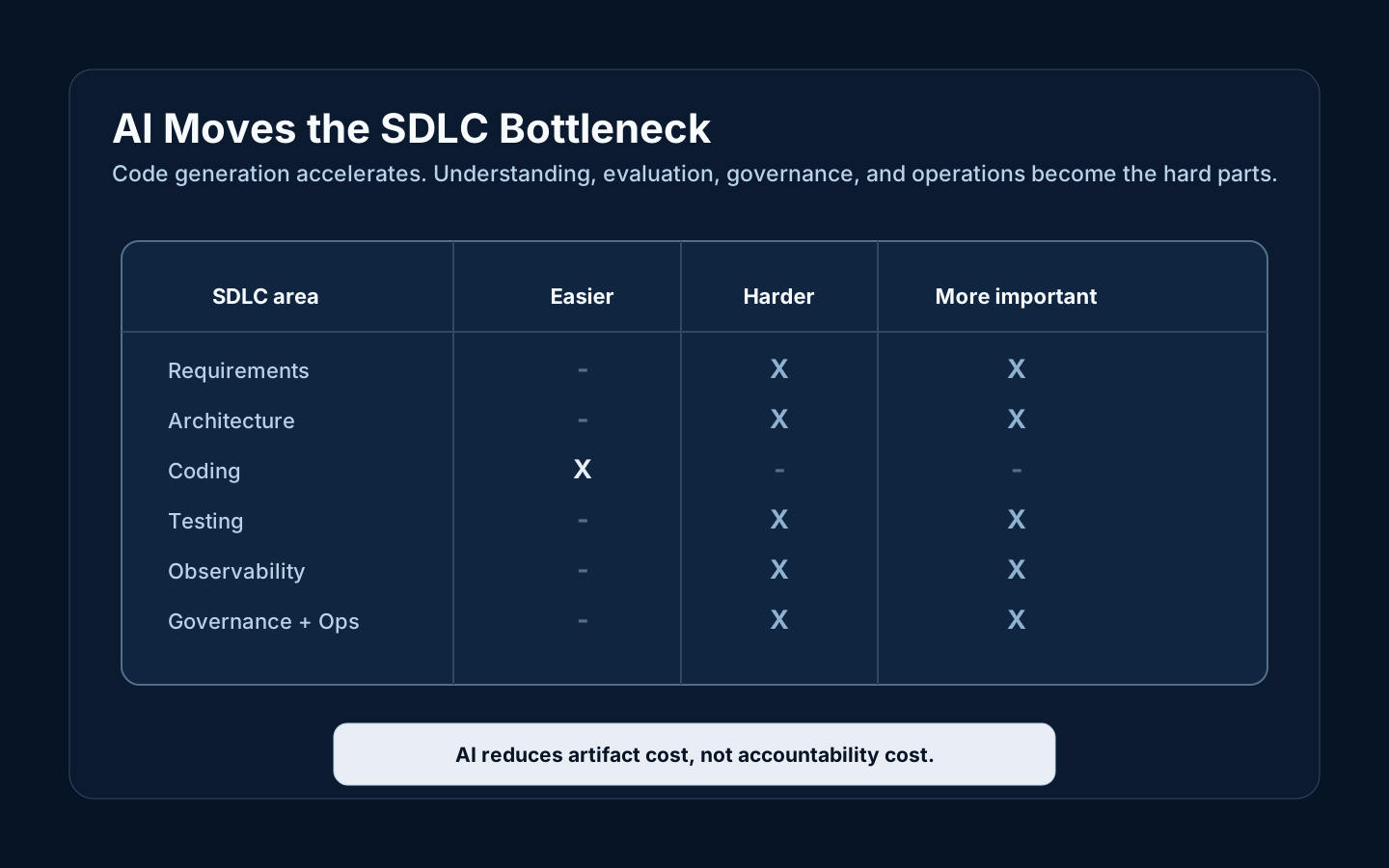
AI is reducing the cost of producing software artifacts. It is not reducing the cost of deciding what should be built, governing how it behaves, or operating it safely at scale.
Executive brief
AI changes the software delivery lifecycle less by eliminating software engineering and more by moving the bottleneck. Coding becomes faster, but requirements, architecture, testing, governance, and operational ownership become more visible and more consequential.
Key takeaways
- The most visible effect of AI is faster code generation, but the more consequential effect is the shift toward lifecycle disciplines.
- Coding accelerates while architecture, testing, governance, and operational ownership become more demanding.
- AI often exposes existing weaknesses in data architecture, governance, ownership, and delivery processes.
- The binding constraint is moving toward evaluation, governance, architecture, and judgment.
- Successful organizations learn to govern, observe, evaluate, and operate AI-enabled systems reliably.
A field guide to what actually changes across requirements, architecture, coding, testing, operations, and governance.
AI is reducing the cost of producing software artifacts. It is not reducing the cost of deciding what should be built, governing how it behaves, or operating it safely at scale.
Series navigation: Part 1 of 3. Next: Part 2 - AI Exposes Problems It Does Not Create. Then: Part 3 - The New Operating Model.
TL;DR
- The most visible effect of AI on software engineering is faster code generation; the more consequential effect is the way it shifts weight onto the rest of the lifecycle - requirements, architecture, testing, observability, governance, and operations.
- Across banks, insurers, engineering organizations, and platform teams, the same pattern recurs: coding accelerates while architecture, testing, governance, and operational ownership become more demanding.
- AI rarely creates entirely new organizational problems. It more often exposes weaknesses that already existed in data architecture, governance, ownership, and delivery processes.
- The binding constraint in software engineering is moving away from software creation and toward evaluation, governance, architecture, and judgment.
- The organizations that succeed with AI are usually not the ones that generate the most code, but the ones that learn to govern, observe, evaluate, and operate AI-enabled systems reliably.
Opening observation
Over the last two years I have taken part in dozens of conversations about AI adoption across banks, insurers, engineering organizations, delivery teams, and platform groups. The industries differed, the technology stacks differed, and the maturity levels varied considerably, yet the conversations tended to follow a similar trajectory.
The first meeting was almost always about the technology. The questions were predictable and reasonable: which model to standardize on, whether to adopt a tool like Copilot or build an internal retrieval system, whether documentation could be automated, whether delivery could be accelerated. AI had arrived with capabilities that were genuinely impressive, and for the first time many engineers could watch working software appear in front of them at a speed that would have seemed unrealistic only a few years earlier.
Several months later, the same conversation usually looked different. The model was rarely the central topic anymore. People were discussing ownership, architecture, testing, governance, platform standards, data access, operational support, and accountability. The focus had moved from what the technology could do toward how the organization would live with it after deployment.
One discussion in particular stays with me. A senior stakeholder had predicted at the outset that AI-assisted development would dramatically reduce delivery effort. Six months later the engineering teams involved confirmed that implementation had indeed accelerated: prototypes appeared faster, internal tools were easier to produce, and documentation improved. What had not happened was the simplification everyone expected. Architecture reviews had become more consequential, because more systems could now be created more quickly. Testing teams found themselves evaluating model behaviour rather than validating deterministic outputs. Governance teams were fielding questions that had never previously appeared in a software delivery discussion. Platform teams discovered that retrieval systems, embeddings, prompts, and model routing all required ownership and operational support. Nobody doubted that AI was useful. The unexpected finding was that software engineering had not become simpler; the difficulty had moved somewhere less visible.
The great misunderstanding
Much of the public discussion around AI and software engineering still assumes that coding is the primary activity in software delivery. The assumption is understandable, because coding is visible, measurable, and easy to demonstrate; when a model produces working code in seconds, the gain is obvious. The difficulty is that coding was never the majority of software engineering effort inside large organizations. Enterprise systems involve requirements discovery, architecture design, testing, observability, security, governance, platform engineering, operational support, compliance review, stakeholder management, release planning, and incident management - a long sequence of activities that exist before and after any code is written. Part of why the current debate feels confused is that attention has settled on the part of the system changing most visibly, while the harder consequences are emerging in the parts that attract less of it.
The industry has been here before. When cloud computing became mainstream, the early discussion centred on infrastructure provisioning, and only in hindsight did the more significant changes - operating models, platform engineering, security, and governance - become the real story. When microservices became popular, the conversation began with service decomposition, and several years passed before many organizations recognized that observability, ownership, and operational complexity were just as central to the outcome. AI appears to be following the same shape. The most obvious change is the acceleration of software creation. The more consequential change is the way it redistributes effort across the rest of the engineering system.
The bottleneck has moved
One of the more useful ways to read the history of software engineering is through the movement of bottlenecks. Compilers reduced the effort of writing machine instructions, frameworks reduced the effort of building infrastructure from scratch, and cloud platforms reduced the effort of provisioning and operating hardware. Each of these solved a genuine problem, and each, in solving it, revealed a different constraint elsewhere in the system. AI appears to be doing the same thing. The current generation of tools is exceptionally good at producing artifacts - code, documentation, test scaffolding, SQL transformations, integration scripts, diagrams, and API specifications can often be generated far faster than before - and the activities that remain difficult are increasingly the ones that depend on judgment. Organizations still have to decide which problems deserve investment, define acceptable behaviour, determine who owns a system, establish how it should be governed, and agree on how success will be measured. Several engineering leaders have described this to me in slightly different words, but the underlying observation is consistent: AI is reducing the cost of production faster than it is reducing the cost of decision-making.
The distinction becomes visible quickly. In one adoption workshop, a team demonstrated an impressive code-generation workflow that was, on its own terms, a technical success. The discussion that followed lasted far longer than the demonstration itself, and almost none of it concerned the generated code. It concerned ownership, review processes, testing obligations, auditability, and operational accountability. The code had become easier to produce; the system around it had not. That pattern repeats. Many organizations begin by assuming that delivery is constrained mainly by implementation effort, and then discover that implementation was only one constraint among several. Once it weakens, the others become easier to see, and the binding constraint migrates toward architecture, evaluation, governance, and ownership - and beneath all of them, toward judgment, which remains considerably harder to automate than code.
Why coding is no longer the most interesting part
Coding is the easiest place to watch AI at work, and for that reason it is becoming one of the less informative places to study its long-term impact. Software generation is improving quickly, and adoption is now close to universal; the categories of work that benefit most clearly - boilerplate, scaffolding, documentation, repetitive transformations, and framework integration - can often be completed noticeably faster than before.
It is worth being careful about the strength of this claim, because the measured picture is more mixed than the surrounding enthusiasm suggests. Developers frequently report substantial time savings, but controlled studies have repeatedly found that self-reported speedups diverge from measured outcomes, and in at least one well-known study experienced developers who believed AI had made them faster were, when measured, somewhat slower. Individual output also does not translate automatically into organizational delivery, since faster drafts only shorten a release when review, integration, and quality assurance move at the same pace. The honest summary is that coding assistance helps, that the benefit is real but uneven, and that its size depends heavily on the task and on the maturity of the surrounding codebase. That uncertainty is itself part of the argument: if even the most measurable, most visible effect of AI resists confident quantification, it is a reasonable signal that the more important effects lie elsewhere.
This is part of why coding is becoming a smaller part of the strategic conversation. Several engineering managers have told me that their teams now spend less time asking whether code can be generated and more time asking whether the generated systems can be understood, validated, governed, and supported. One platform lead described the change to me as a shift from whether they could build something toward whether they should operate it - a small rephrasing that captures a real movement in where the difficulty now sits. The industry spent roughly the last two years establishing that AI can generate software. The next few will likely be spent learning how to evaluate, govern, and operate the software it generates.
Next in the series: Part 2 - AI Exposes Problems It Does Not Create.
References
- DORA: State of AI-assisted Software Development 2025 — Research on AI-assisted software development, delivery performance, organizational capabilities, and the amplifier effect of AI.
- arXiv: The Impact of AI on Developer Productivity - Evidence from GitHub Copilot — Controlled study reporting a 55.8 percent faster task-completion result for GitHub Copilot users.
- GitHub: Quantifying Copilot's impact in the enterprise with Accenture — Enterprise research context for AI-assisted coding adoption, satisfaction, and productivity variation.
- TechRadar Pro: Observability was built for humans. AI agents need something different — Analysis of why AI agents create new observability requirements beyond traditional human-centric telemetry.
- arXiv: AI Assurance - A Comprehensive Testing Strategy for Enterprise AI Systems — Research framing enterprise AI testing as continuous assurance and risk reduction rather than deterministic verification.
- arXiv: Cryptographic Runtime Governance for Autonomous AI Systems — Runtime-governance architecture research treating policy and legal constraints as execution conditions.
Author
Géza Kuti is a senior Data and AI executive based in Bülach (ZH), Switzerland, focused on data strategy, enterprise architecture, AI governance, hybrid cloud, and regulated delivery.
Related expertise
Related articles
When the Model Became a Critical Dependency
The Fable 5 shutdown showed that frontier models can become externally controlled dependencies for regulated enterprises. That changes how firms should think about sovereignty, portability, concentration risk, and operational resilience.
AI Is Global. Government Data Is Not
Frontier AI models are global, but government and regulated data remain jurisdictional. This article explains why sovereign AI is becoming the default architecture across Europe.
Why Most Public Sector AI Strategies Fail During Implementation
Most governments now have AI strategies, principles, and playbooks. The harder question is whether they have the delivery machinery to turn those documents into safe production systems.