AI Governance
Enterprise AI Adoption: Why Most Programs Stall Between Pilot and Production
The most common enterprise AI failure is rarely model failure; it is the failure to build an operating environment capable of supporting the model once the pilot ends.
Executive brief
Enterprise AI adoption is now widespread, but production-scale operationalization remains uneven. The organizations that move durably beyond pilots tend to invest in governed data access, workflow redesign, platform foundations, operational ownership, evidence production, and organizational learning at least as seriously as they invest in models.
Key takeaways
- Pilot success does not establish enterprise readiness; the two stages test different things.
- The binding constraint is usually the operating environment around the model rather than the model itself.
- AI adoption behaves less like a technology deployment and more like a data, governance, and workflow transformation.
- Governance becomes a runtime concern once AI systems consume enterprise data continuously rather than episodically.
- Production AI rewards ownership, platform discipline, evidence production, and organizational learning.
The most common enterprise AI failure is rarely model failure; it is the failure to build an operating environment capable of supporting the model once the pilot ends.
TL;DR
Enterprise AI adoption is progressing far more unevenly than the public narrative suggests. Experimentation is nearly universal, but durable production operation is not, and many organizations have accumulated dozens of pilots while only a few have crossed into reliable enterprise use. The dominant obstacles are rarely model quality; they are data fragmentation, governance gaps, ownership ambiguity, weak workflow integration, and immature operating models. AI tends to expose weaknesses that already existed in enterprise data architecture rather than create new ones, and governance increasingly has to operate at runtime because these systems consume data continuously rather than episodically. The organizations generating measurable value invest in platform foundations, workflow redesign, governance, and organizational learning at least as heavily as they invest in models — which suggests the next phase of enterprise AI will be defined less by model capability than by architecture, operational discipline, evidence production, and governance execution.
Opening observation
Last year, in a discussion about AI adoption inside a large financial-services organization, someone presented a slide listing more than thirty AI initiatives. The list was genuinely impressive: internal copilots, document assistants, code-generation tools, retrieval systems, operational automation experiments, and several early agentic workflows. The organization had invested real time and money, executive sponsorship was visible, and the teams involved were capable.
The discussion changed when someone asked which of those systems were actually running inside critical business workflows that day. The room grew quieter. A few were in regular use, several had reached controlled production environments, and a small number had produced measurable productivity improvements, but many remained somewhere between proof of concept and enterprise deployment. Nobody treated this as failure, and it was not presented as one. What nobody in the room could explain with much confidence was how most of those pilots would become durable operational capabilities.
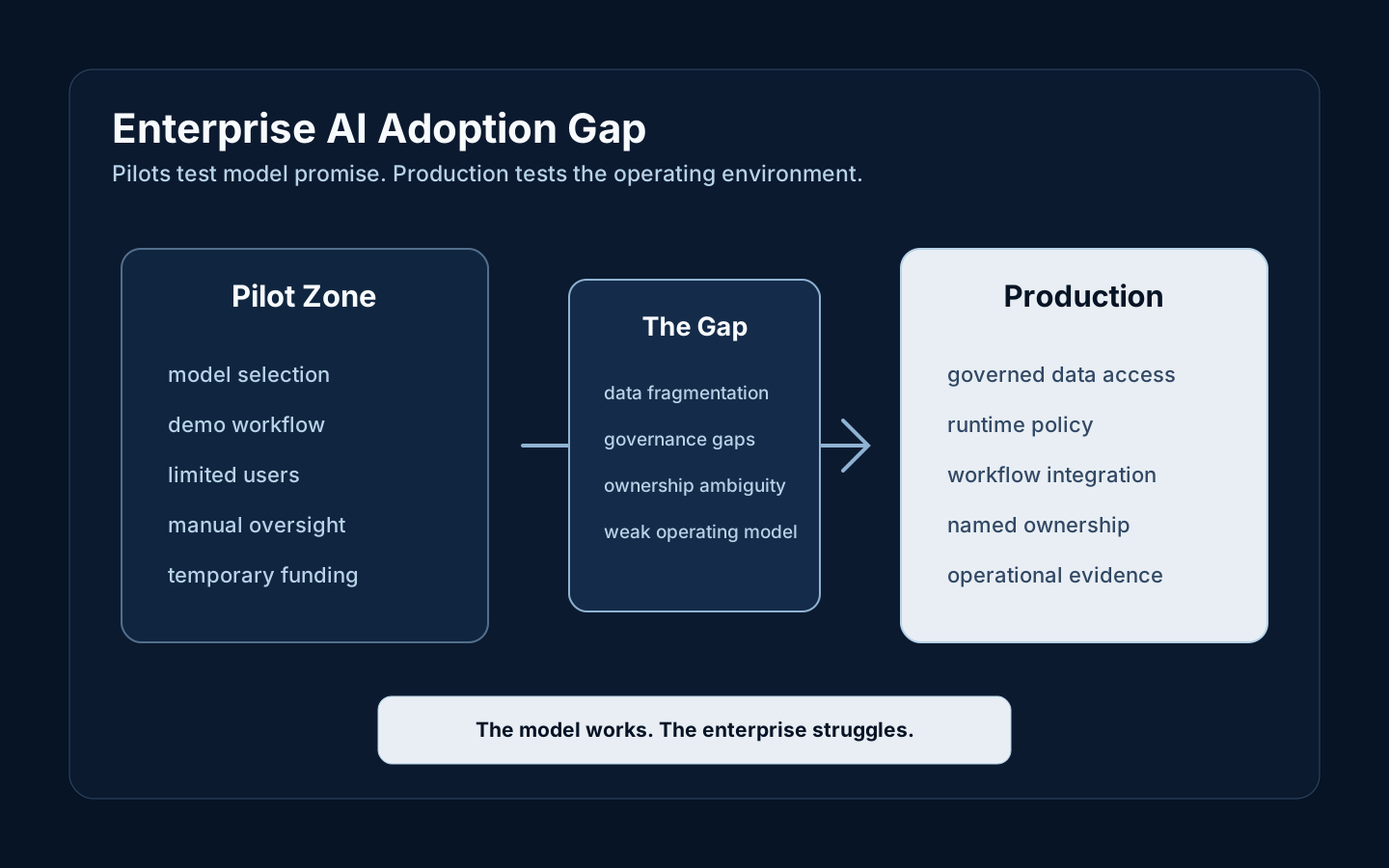
That distinction has stayed with me, because I have watched versions of the same conversation play out repeatedly over the last two years across banks, insurers, public-sector organizations, engineering groups, and large enterprise technology teams. The pattern is consistent enough to state plainly: the model works, the pilot works, and the enterprise struggles to operationalize either.
The adoption paradox
The current AI market sustains two narratives at once, and both are accurate. The first is that adoption is happening very quickly, which the data broadly supports: McKinsey's 2025 global AI survey describes AI use expanding rapidly across enterprises, with a large majority of organizations now reporting AI use in at least one business function. The second is that many of those same organizations remain stuck in experimentation, which the same body of research also supports, describing a landscape where broad usage and agentic experimentation coexist with a still-difficult transition from pilots to scaled enterprise impact. These two realities are not in tension. Widespread usage and durable enterprise-scale operation are simply different states, and most of the current difficulty lives in the distance between them.
Pilot success is frequently mistaken for enterprise readiness
Part of what makes AI adoption discussions confusing is that organizations often read pilot success as evidence that scaling will be straightforward, when in practice the pilot and the production system test almost entirely different things. A pilot tends to evaluate model capability, user reaction, workflow fit, and technical feasibility. Production evaluates governance, operational ownership, reliability, auditability, integration, security, supportability, and organizational accountability. These are not variations on a single problem; they are different problems, and competence at the first does not transfer cleanly to the second.
Recent enterprise analyses point in the same direction: a large share of pilots fail to reach production not because the model underperforms but because the surrounding operating environment was never designed to support it. One engineering leader put it to me more bluntly, observing that the AI part of the work had turned out to be easier than settling who owned the result. It sounds like a throwaway remark, but it identifies the constraint precisely, because ownership is exactly the kind of question that a pilot is structured to defer and that production is structured to demand.
The model is usually not the bottleneck
Public AI discussion still devotes considerable energy to comparing models, yet inside enterprises the model often stops being the primary constraint surprisingly early. Modern foundation models already handle summarization, retrieval, classification, code generation, document analysis, and increasingly capable agentic behaviour, and the capability curve continues to improve. The more persistent barriers appear elsewhere, and several recent enterprise studies converge on a similar list: fragmented data, weak governance, ownership ambiguity, workflow integration problems, and organizational coordination failures.
A pattern I have observed repeatedly is that AI initiatives begin as model-selection discussions and gradually become data architecture discussions. The first meetings concern model quality, copilots, retrieval frameworks, and vendor choices. Six months later, the same teams are discussing access controls, metadata quality, lineage, governance review processes, platform ownership, legal approval, and operational accountability. The model has not become unimportant — it remains central — but the architecture around it steadily becomes the harder part of the problem, and the centre of gravity moves accordingly.
The hidden data architecture problem
Many organizations still describe AI adoption as a technology transformation. Operationally, it behaves much more like a data transformation, because AI systems depend heavily on discoverability, semantic consistency, retrieval quality, governance, metadata, lineage, and policy enforcement. Weaknesses that remained manageable in traditional reporting environments — where consumption was periodic and human-paced — become considerably more visible once an AI system begins consuming enterprise data continuously.
One banking organization I worked with built a promising internal retrieval assistant. The demonstrations were strong, and employees liked the system almost immediately. The difficulties surfaced during broader rollout, when it became clear that different departments were using different definitions for the same business concepts, that several important datasets had unclear ownership, that access rights varied across environments, that metadata quality was inconsistent, and that historical context was missing in places. None of these problems were caused by the model. The model simply became the first consumer aggressive enough to expose them, and that is the pattern more often than not: AI does not so much eliminate data architecture problems as make them impossible to ignore.
Governance becomes operational
Many governance programs were designed around relatively predictable consumption patterns — reports, dashboards, applications, and human users acting at human speed. AI systems behave differently, and questions that previously arose only occasionally become continuous: which datasets are being consumed, under what authority, for what purpose, by which system, and whether the organization can reconstruct that chain afterward and show that downstream restrictions were respected. These questions become substantially harder as organizations move toward agentic systems.
Recent research on industrial agentic AI adoption describes a capability-deployment gap in which organizations can demonstrate experimental capabilities they cannot yet operationalize, because verification, governance, and trust mechanisms remain immature, leaving human review as the only mechanism they fully trust. That aligns closely with what many enterprises are experiencing: the technology is advancing more quickly than the governance model around it, and the widening distance between the two is becoming one of the defining operational risks of enterprise AI adoption.
The operating model problem
One of the clearer patterns across successful AI deployments is that the organizations eventually stop treating AI as a tooling initiative and begin treating it as an enterprise capability. This sounds like management language, but it carries concrete operational consequences. Organizations that scale AI successfully tend to establish explicit executive ownership, platform ownership, governance ownership, adoption structures, funding models, and operational accountability, whereas organizations that struggle tend to distribute responsibility across disconnected pilots that never add up to a capability anyone owns. The strongest differentiators increasingly look like leadership alignment, governance discipline, workflow integration, and operating-model maturity rather than model sophistication. The pilot phase rewards enthusiasm; production rewards coordination, and those turn out to be different organizational capabilities that do not automatically follow from one another.
What changes in the AI SDLC, and what does not
A recurring misconception is that AI has reinvented software delivery wholesale. Some parts have changed substantially while others have changed far less than expected. The areas that genuinely change include data dependency, evaluation methodology, retrieval architecture, model lifecycle management, governance, observability, and human-oversight requirements. The areas that remain surprisingly familiar include architecture discipline, platform engineering, testing rigour, release management, ownership, operational support, and security review.
A large-scale deployment study from WhatsApp, published as WhatsCode: Large-Scale GenAI Deployment for Developer Efficiency at WhatsApp, reaches a compatible conclusion. The most successful deployment did not rest on full automation; it depended on carefully designed human-AI operating models, ownership structures, and production engineering discipline. The novelty sat inside the model, but the reliability still came from the surrounding engineering — the same lesson that arrives, in different form, from almost every other part of this discussion.
What organizations that are progressing seem to do differently
Across sectors, several habits recur among organizations that have moved beyond the pilot stage. They tend to focus on a smaller number of operationally meaningful use cases rather than a broad portfolio of experiments. They invest in governance and platform foundations earlier than feels comfortable. They integrate AI into existing workflows instead of running it as a separate innovation programme. They establish ownership structures before large-scale rollout rather than after the first incident forces the question. And they treat adoption as cumulative organizational learning rather than a one-time deployment. Recent research framing AI readiness as an organizational learning problem rather than a technology purchase supports this view, and the framing is increasingly useful: readiness behaves less like procurement and more like capability development that compounds over time.
What I would do Monday morning
If I were reviewing an enterprise AI programme today, I would spend less time comparing models and more time examining operational readiness. A small number of questions tend to reveal more than any model inventory:
- Which AI systems are genuinely running inside production workflows, as opposed to demonstrations or controlled pilots?
- Which datasets are feeding those systems, and can the organization reconstruct that consumption chain on request?
- Who owns the AI operating model, with real budget and accountability rather than nominal sponsorship?
- Where does governance actually execute — inside the running system, or only in approved documents?
- Which pilots have a credible path into operational workflows, and which are likely to remain demonstrations?
- Which systems still depend on human-oversight patterns that will not scale as volume grows?
The answers usually reveal more about AI maturity than the model inventory.
The tradeoff most organizations discover late
Enterprise AI adoption is usually described as an acceleration story, and it is also, less comfortably, a governance story. Organizations that move successfully into production tend to accept additional operational overhead — governance, observability, platform engineering, evidence generation, policy enforcement, workforce adaptation, and change management — and that overhead introduces real friction. The alternative, though, is the quieter failure mode of pilot accumulation without operationalization: a growing portfolio of impressive demonstrations that never become dependable capabilities. Many organizations eventually discover that scaling AI demands more structure than experimentation does, and that realization tends to arrive later than anyone planned for.
Closing reflection
The most interesting thing about enterprise AI adoption today is not how many pilots exist. It is how many organizations are arriving at the same realization: the pilot was the easy part. The industry has largely demonstrated that modern models are capable. The next phase will determine whether enterprises can build the architectures, governance systems, operating models, and organizational disciplines required to make that capability durable.
The organizations that succeed will probably not be the ones with access to the most advanced model. They are more likely to be the ones that learn to connect models, data, governance, evidence, workflows, and operational ownership into a coherent system that can be operated and defended over time. That has consistently turned out to be a harder problem than model selection, and it is increasingly the real work of enterprise AI adoption.
Part of the SDOP series on regulator-defensible architecture, enterprise AI governance, operating models, and continuous modernization.
References
- McKinsey: The state of AI in 2025 — Global survey context for widespread AI use, agentic AI experimentation, and the uneven transition to scaled enterprise impact.
- MIT NANDA: The GenAI Divide - State of AI in Business 2025 — Research report on the gap between enterprise AI experimentation and measurable business impact.
- arXiv: Agentic AI in Industry - Adoption Level and Deployment Barriers — Industrial evidence on capability-deployment gaps, verification barriers, and production integration challenges for agentic AI.
- arXiv: WhatsCode - Large-Scale GenAI Deployment for Developer Efficiency at WhatsApp — Large-scale deployment study highlighting ownership models, adoption dynamics, risk management, and human-AI collaboration patterns.
- arXiv: Why AI Readiness Is an Organizational Learning Problem, Not a Technology Purchase — Research framing AI readiness as capability development across culture, operations, data architecture, infrastructure, and governance.
Author
Géza Kuti is a senior Data and AI executive based in Bülach (ZH), Switzerland, focused on data strategy, enterprise architecture, AI governance, hybrid cloud, and regulated delivery.
Related expertise
Related articles
When the Model Became a Critical Dependency
The Fable 5 shutdown showed that frontier models can become externally controlled dependencies for regulated enterprises. That changes how firms should think about sovereignty, portability, concentration risk, and operational resilience.
AI Is Global. Government Data Is Not
Frontier AI models are global, but government and regulated data remain jurisdictional. This article explains why sovereign AI is becoming the default architecture across Europe.
Why Most Public Sector AI Strategies Fail During Implementation
Most governments now have AI strategies, principles, and playbooks. The harder question is whether they have the delivery machinery to turn those documents into safe production systems.