Data Architecture
DataOS, Mesh, Fabric, Lakehouse — and What Comes After
A genealogy of modern data architectures and why the next architectural generation is likely to be defined by sovereignty, evidence, and governed AI consumption.
Answer summary
Modern data architecture has evolved through successive optimization targets: consistency, scale, analytical convergence, organizational ownership, metadata automation, and unified operational experience. DataOS is the closest precedent to SDOP, but regulated enterprises now need patterns that add sovereignty, evidence production, portability, and governed AI consumption across federated trust boundaries.
Key takeaways
- Each architectural generation solved a different constraint.
- DataOS is the closest current precedent to SDOP.
- Most architectures assume a unified trust boundary.
- Regulated enterprises increasingly operate across multiple sovereign realities.
- The next architecture must produce evidence continuously.
Every architectural generation solved a real problem. The problem is that the next generation of enterprise constraints is no longer the same problem.
TL;DR
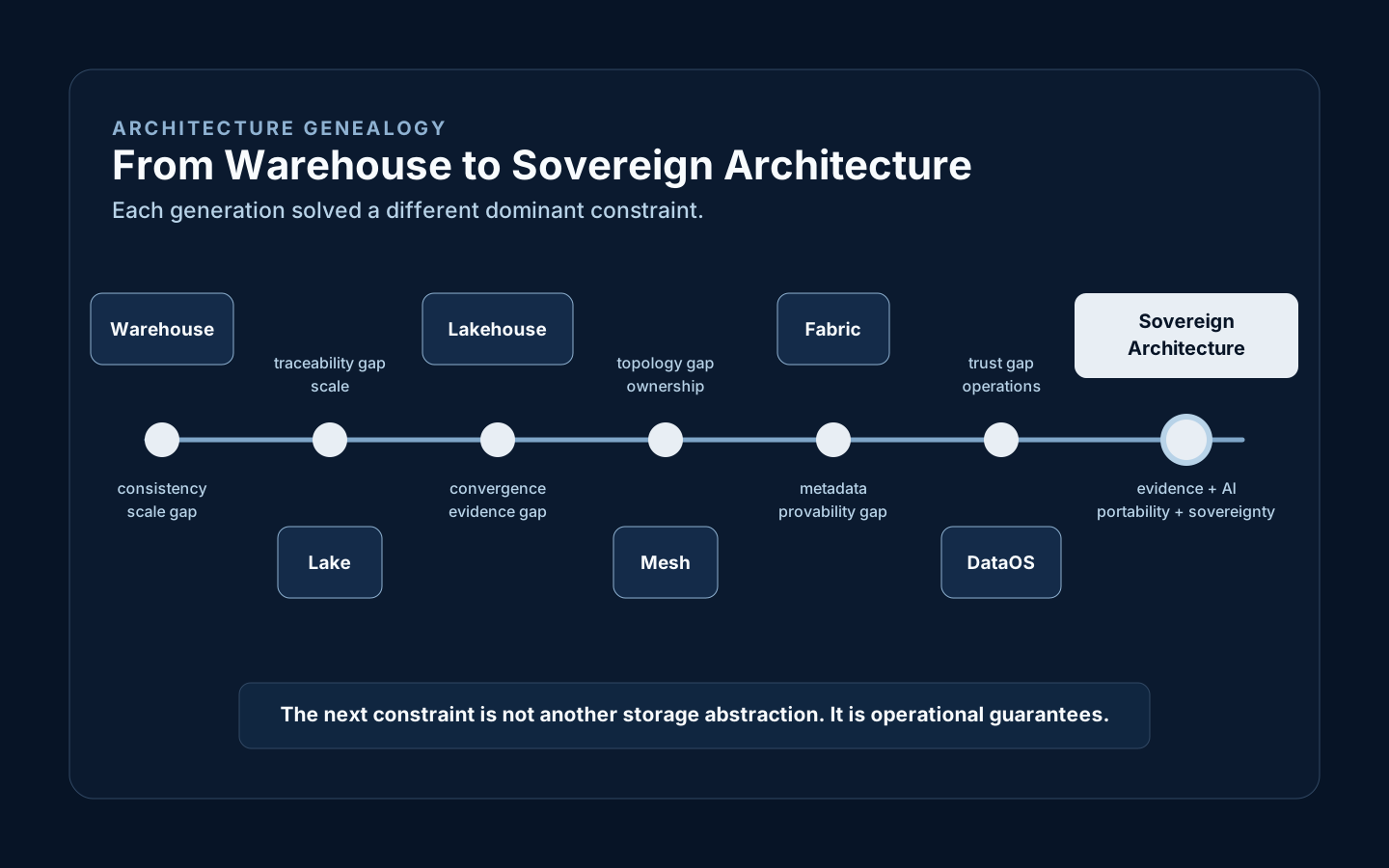
- Modern enterprise data architecture evolved through a sequence of optimization targets: consistency, scale, analytical convergence, organizational ownership, metadata automation, and unified operational experience.
- DataOS is the closest current architectural precedent to SDOP because it correctly recognizes that enterprises increasingly need integrated operational data systems rather than disconnected tooling stacks.
- However, most public DataOS implementations still assume a relatively unified logical control plane and trust boundary.
- That assumption breaks under modern regulated-enterprise realities involving sovereign residency, AI governance, DORA portability requirements, BCBS 239 evidence expectations, and multi-jurisdiction enforcement.
- Data mesh solved important organizational problems but underestimated sovereign and evidentiary topology.
- Data fabric solved orchestration and metadata visibility but not regulator-defensible evidence continuity.
- The next architectural pattern must combine residency-aware federation, evidence as infrastructure, operational portability discipline, and governed AI consumption.
Opening observation
One of the more interesting things about enterprise architecture is how quickly each generation becomes obvious in hindsight.
At the time, every wave feels revolutionary.
Warehouses.
Lakes.
Lakehouses.
Mesh.
Fabric.
DataOS.
Each arrives with:
- a new vocabulary,
- a new abstraction layer,
- and usually a strong claim that fragmentation has finally been solved.
Then a few years later, the industry quietly realizes something uncomfortable:
The previous generation solved the previous generation's bottleneck.
Not the next one.
That does not mean the architecture failed.
Most of these patterns solved genuine enterprise problems:
- scale,
- decentralization,
- metadata visibility,
- cloud economics,
- organizational ownership.
The problem is that the constraints inside regulated enterprises have shifted again.
And the shift is deeper than many organizations currently appreciate.
Because the next pressure wave is no longer primarily about:
- storage,
- orchestration,
- or analytical scalability.
It is increasingly about:
- regulator-defensible evidence,
- sovereign topology,
- continuous portability,
- and governed AI consumption.
That changes the architectural center of gravity significantly.
The warehouse era: centralized truth
The warehouse generation emerged from a world where the primary problem was inconsistency.
Operational systems were fragmented.
Reporting definitions diverged.
Executives distrusted numbers.
The warehouse solved this through:
- centralization,
- modeling discipline,
- controlled ETL,
- and semantic standardization.
Inmon and Kimball represented slightly different philosophies, but both optimized around a similar assumption:
The enterprise benefits from converging toward a controlled analytical truth.
And for a long time, this worked remarkably well.
Warehouses produced:
- consistency,
- auditability,
- and relatively strong reporting governance.
In hindsight, warehouses were often structurally closer to regulator expectations than many later architectures.
Not because they were more advanced.
But because they were constrained.
The problem was scale.
Eventually:
- cloud economics,
- unstructured data,
- machine learning,
- and enterprise heterogeneity
simply exceeded what centralized warehouse models could comfortably absorb.
The lake era: scale becomes the constraint
Data lakes represented a dramatic inversion.
Instead of:
- model first,
- govern first,
- structure first,
the philosophy became:
- ingest first,
- scale first,
- structure later.
This solved a critical enterprise bottleneck.
For the first time, organizations could realistically:
- retain enormous data volumes,
- support ML workloads,
- ingest semi-structured data,
- and decouple storage from compute economics.
Architecturally, this was a huge shift.
But it introduced a different failure mode.
The lake optimized for:
analytical possibility rather than evidentiary certainty.
Over time, many enterprises accumulated:
- schema drift,
- fragmented ownership,
- duplicated transformations,
- inconsistent semantics,
- and weak lineage continuity.
The data swamp cliché became popular for a reason.
The industry gained flexibility.
But often lost provability.
The lakehouse era: reconciliation
The lakehouse wave attempted to reconcile the strengths of warehouses and lakes.
This was an important and mostly correct architectural move.
ACID transactions.
Open table formats.
Unified analytics.
Governed ML pipelines.
Metadata convergence.
The lakehouse succeeded because it acknowledged a reality many enterprises had already discovered operationally:
Pure flexibility without governance becomes unstable.
Lakehouse architectures solved major problems around:
- performance,
- governance,
- streaming,
- ML integration,
- and analytical convergence.
Open table formats like Apache Iceberg and Delta Lake were especially important because they introduced a more portable storage abstraction layer.
But again: the primary optimization target remained analytical convergence.
Not regulator-defensible evidence production.
That distinction matters more than it initially appears.
Because a lakehouse can:
- process petabytes efficiently,
- support AI pipelines,
- unify governance catalogs,
- and still struggle with:
- attribute-level lineage,
- evidence continuity,
- historical policy reconstruction,
- and sovereign enforcement topology.
The architecture became operationally stronger.
But not yet evidentiary.
The mesh era: organizational reality finally arrives
Data mesh was one of the first modern architectural movements that explicitly recognized organizational structure as part of the problem.
This was important.
Because many centralized platform programs were already collapsing under:
- enterprise scale,
- domain complexity,
- and governance bottlenecks.
Zhamak Dehghani's core insight was correct and influential:
Enterprises are not monoliths. Data ownership must become federated.
Mesh solved several real problems:
- domain accountability,
- local ownership,
- product thinking,
- decentralized governance.
And in practice, many enterprises genuinely improved after adopting mesh principles.
But mesh also inherited an assumption that becomes difficult under heavily regulated multinational conditions:
- a relatively coherent governance boundary.
That assumption breaks under:
- sovereign cloud segmentation,
- cross-border residency restrictions,
- regulator-specific evidence obligations,
- and AI governance overlays.
In other words: mesh solved organizational decentralization.
But it did not fully solve sovereign evidentiary federation.
Those are different architectural problems.
The fabric era: metadata everywhere
Data fabric emerged partly as a response to fragmentation fatigue.
The realization was straightforward:
- the enterprise would remain heterogeneous,
- therefore orchestration and metadata had to become more intelligent.
Fabric architectures emphasized:
- active metadata,
- automated lineage,
- semantic discovery,
- governance automation,
- and cross-system observability.
This solved another important enterprise bottleneck: visibility.
Architecturally, fabrics were often strongest at:
- orchestration,
- discovery,
- policy routing,
- and metadata federation.
But fabrics largely optimized for:
metadata awareness rather than evidentiary certainty.
This distinction matters.
Because metadata visibility does not automatically create:
- signed evidence,
- non-repudiation,
- historical policy reproducibility,
- or portability continuity.
The architecture became more observable.
Not necessarily more provable.
DataOS: the closest precedent
DataOS is the closest current intellectual neighbor to SDOP.
And importantly: I think the core intuition behind DataOS is directionally correct.
The central realization of the DataOS movement is that:
enterprises increasingly need operational data systems rather than disconnected tooling stacks.
That insight matters enormously.
Most large enterprises already operate:
- orchestration layers,
- catalogs,
- governance engines,
- contracts,
- AI infrastructure,
- observability systems,
- and portability tooling simultaneously.
Treating these as disconnected concerns increasingly creates operational fragmentation.
DataOS correctly recognizes the need for:
- compositional architecture,
- operational abstraction,
- integrated governance,
- and policy-aware runtime behavior.
That is an important shift.
In many ways, DataOS is the first modern architecture movement that starts thinking in terms of:
- operational planes,
- runtime governance,
- and integrated enterprise behavior.
That is why it matters.
Where DataOS becomes enterprise-naive
The problem is not the direction.
The problem is the trust model.
Most public DataOS reference implementations still implicitly assume:
- a relatively unified logical control plane,
- a coherent trust boundary,
- and governance operating inside a mostly integrated operational topology.
That assumption becomes increasingly fragile under:
- FINMA residency expectations,
- DORA portability obligations,
- EU AI Act evidence requirements,
- BCBS 239 lineage expectations,
- GxP validation,
- IFRS 17 traceability,
- and multinational sovereign segmentation.
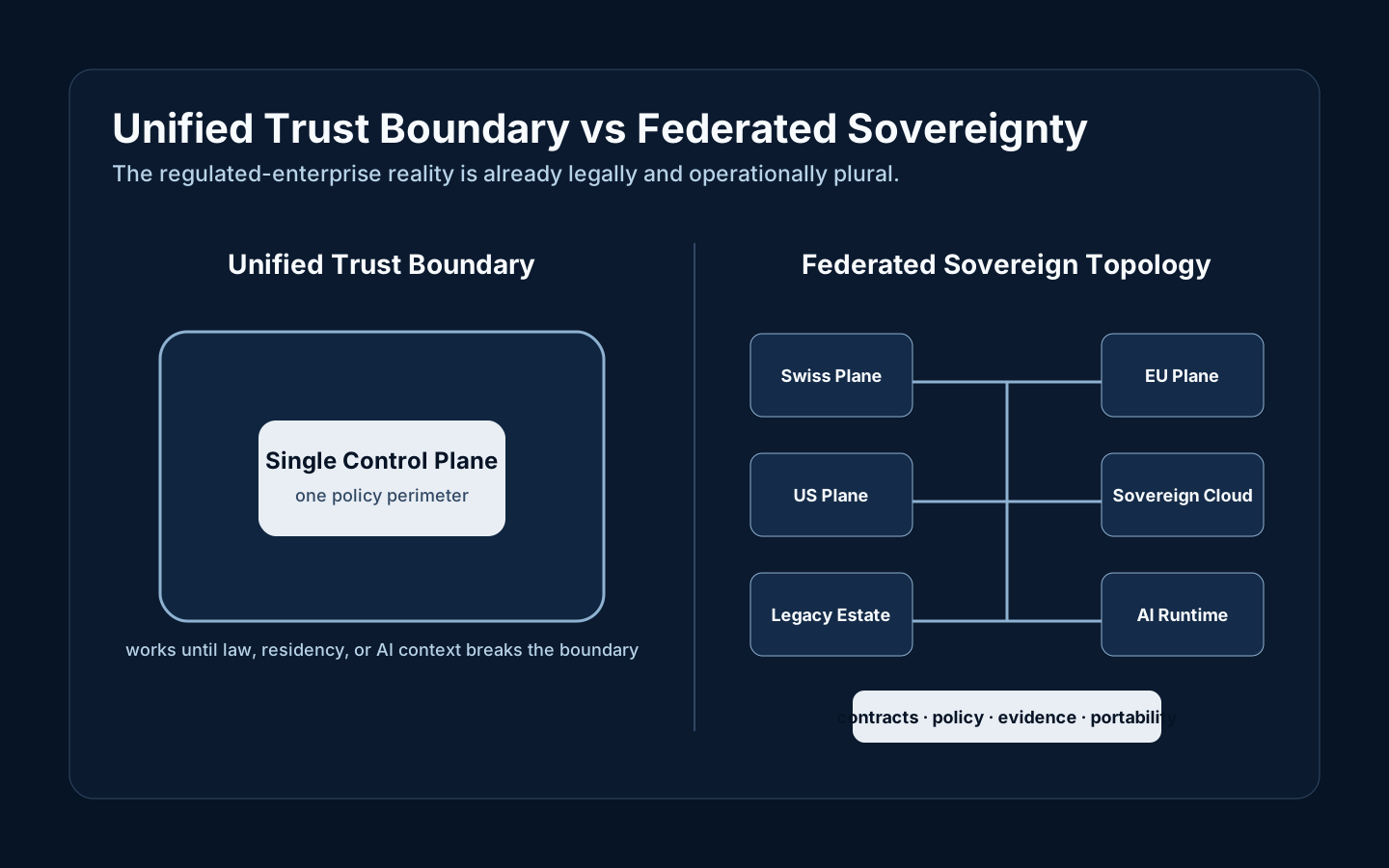
A Swiss-regulated bank does not operate inside a single trust boundary anymore.
Neither does a multinational pharmaceutical company.
Neither does a post-merger financial institution.
The architecture is already federated:
- legally,
- operationally,
- politically,
- and geographically.
That means the next architecture cannot merely orchestrate complexity.
It must govern sovereign fragmentation explicitly.
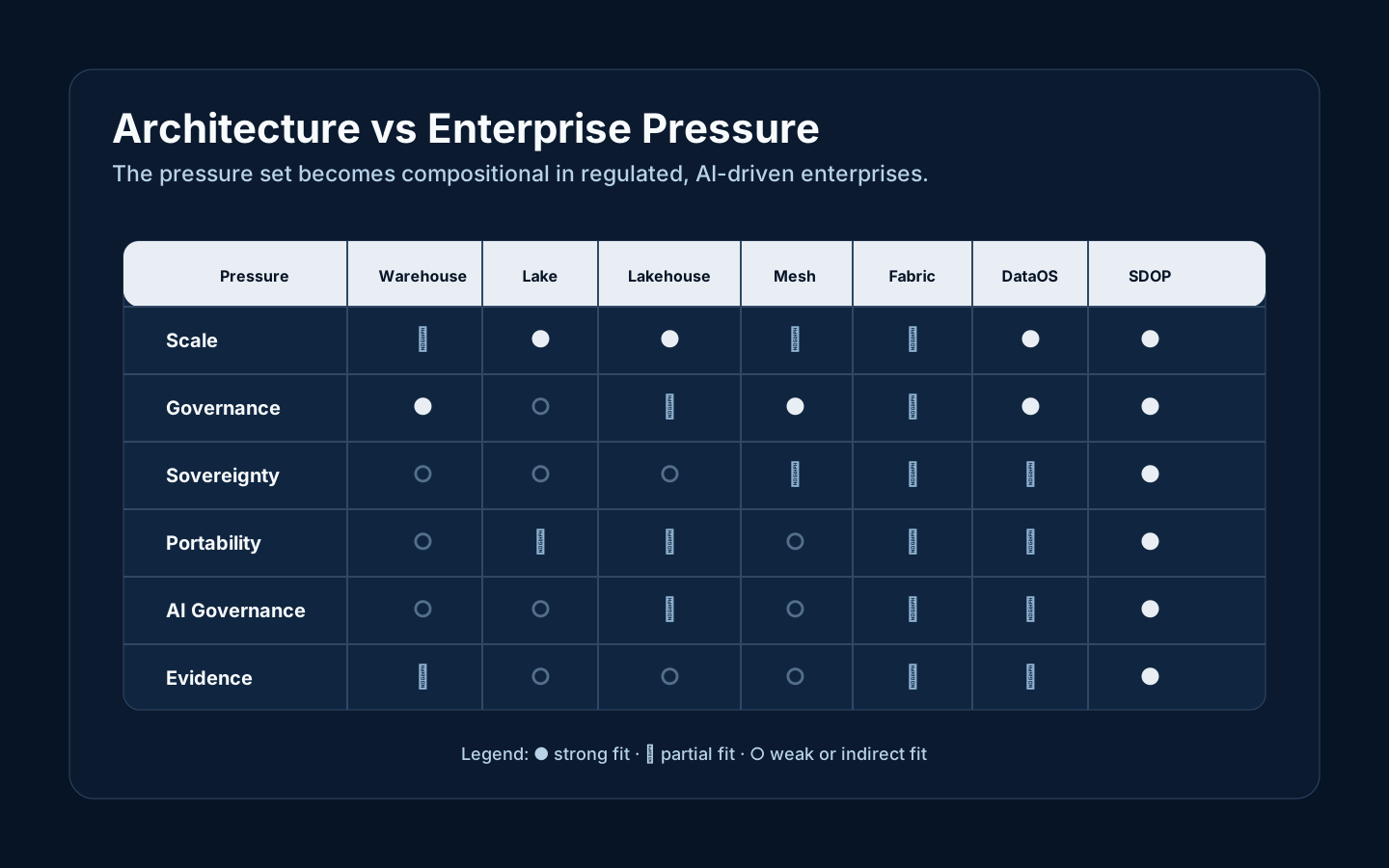
What the next architecture must do differently
This is where the architectural shift becomes important.
The next pattern likely needs five capabilities simultaneously.
1. Residency-aware federation
The architecture must treat jurisdiction as a first-class concern.
Not:
- a deployment configuration,
- or a compliance overlay.
The topology itself becomes sovereignty-aware.
That is a major conceptual shift.
2. Evidence as continuous output
Most architectures still treat evidence as:
- documentation,
- reporting,
- or retrospective reconstruction.
The next generation likely treats evidence as:
a continuous operational output of the architecture itself.
That changes:
- lineage,
- policy enforcement,
- auditability,
- AI governance,
- and portability semantics.
Substantially.
3. Operational portability discipline
Open formats alone are insufficient.
Real portability increasingly requires:
- exercised failover,
- equivalence proofs,
- lineage continuity,
- migration evidence,
- and continuous testing discipline.
Portability becomes operational rather than aspirational.
4. Agentic governance
Most current governance models still assume:
- human consumers,
- dashboard usage,
- API access,
- static authorization patterns.
AI agents break those assumptions.
The architecture must increasingly govern:
- autonomous consumption,
- purpose binding,
- reasoning traceability,
- and policy mediation at runtime.
This is still operationally immature across the industry.
But the pressure is arriving quickly.
5. Federated trust rather than centralized illusion
This may ultimately be the most important shift.
Many modern architectures still implicitly assume:
- eventual central convergence.
I increasingly think regulated enterprises are moving the opposite direction:
- toward federated operational realities,
- connected through contracts, evidence, policy, and portability layers.
That is a different architectural worldview.
Why this matters commercially
The commercial implication is important.
If the architecture depends on:
- one cloud,
- one vendor,
- one governance runtime,
- one control plane,
- or one trust model,
then portability and sovereignty eventually become compromised.
That is why SDOP is intentionally framed as:
a publishable architectural pattern rather than a product category.
The runtime substrates can evolve.
The architectural guarantees remain the important part.
That distinction becomes strategically valuable in:
- regulated industries,
- sovereign environments,
- and long-lived enterprise systems.
What I would do Monday morning
If I were evaluating enterprise architecture direction today, I would ask five uncomfortable questions.
- Which assumptions in our architecture still depend on a unified trust boundary?
- Can our evidence survive a substrate migration?
- Could we prove AI consumption lineage continuously today?
- Have we operationally exercised portability or only described it?
- Which parts of our governance model still assume human consumers only?
Those questions reveal more about architectural maturity than most capability matrices.
The tradeoff most people ignore
Every architectural generation creates new complexity while solving old complexity.
Mesh created governance complexity while solving ownership complexity.
Fabric created metadata complexity while solving visibility complexity.
DataOS risks creating control-plane concentration while solving orchestration fragmentation.
The next architecture will not eliminate complexity.
It will likely redistribute it:
- toward sovereignty,
- evidence,
- portability,
- and runtime governance.
That redistribution is expensive.
But increasingly unavoidable.
Closing reflection
In hindsight, the evolution from:
- warehouse,
- to lake,
- to lakehouse,
- to mesh,
- to fabric,
- to DataOS
looks surprisingly coherent.
Each generation responded rationally to the dominant enterprise constraint of its time.
The next constraint appears different.
The next architecture will likely not be defined primarily by:
- storage abstraction,
- metadata automation,
- or analytical convergence.
It will likely be defined by whether enterprises can continuously:
- prove,
- govern,
- port,
- and mediate
their data across sovereign, AI-driven, permanently modernizing environments.
That is the pressure wave now arriving.
And it requires a different architectural premise than the previous generations were designed for.
Part of the SDOP series on regulator-defensible architecture, sovereign data systems, enterprise AI governance, and continuous modernization.
References
- Kimball Group: Dimensional modeling techniques — Reference for dimensional modeling and warehouse-era design discipline.
- Zhamak Dehghani: How to move beyond a monolithic data lake to a distributed data mesh — Foundational data mesh essay.
- Gartner: What is data fabric? — Data fabric and active metadata framing.
- DataOS documentation: Architecture of DataOS — DataOS architecture reference.
- Databricks documentation: Data Intelligence Platform — Databricks platform and lakehouse reference.
- Snowflake documentation: Horizon Catalog — Snowflake governance and discovery reference.
- Palantir Foundry documentation: Ontology overview — Operational ontology reference.
- OpenLineage documentation — Open lineage framework referenced for lineage architecture.
- Apache Iceberg table specification — Open table format specification referenced in the lakehouse and portability discussion.
- BIS: Principles for effective risk data aggregation and risk reporting — BCBS 239 risk data aggregation and reporting principles.
- EUR-Lex: Regulation (EU) 2022/2554 on digital operational resilience — DORA regulation text.
- FINMA Circular 2023/1: Operational risks and resilience - banks — Swiss operational risk and resilience circular.
- EUR-Lex: Regulation (EU) 2024/1689 Artificial Intelligence Act — EU AI Act official journal text.
Author
Géza Kuti is a senior Data and AI executive based in Bülach (ZH), Switzerland, focused on data strategy, enterprise architecture, AI governance, hybrid cloud, and regulated delivery.
Related articles
When the Model Became a Critical Dependency
The Fable 5 shutdown showed that frontier models can become externally controlled dependencies for regulated enterprises. That changes how firms should think about sovereignty, portability, concentration risk, and operational resilience.
AI Is Global. Government Data Is Not
Frontier AI models are global, but government and regulated data remain jurisdictional. This article explains why sovereign AI is becoming the default architecture across Europe.
Why Most Public Sector AI Strategies Fail During Implementation
Most governments now have AI strategies, principles, and playbooks. The harder question is whether they have the delivery machinery to turn those documents into safe production systems.