SDOP
Pattern, Not Product: What a Sovereign Data Operating Plane Actually Is
The next generation of enterprise data architecture is likely to be defined less by storage and more by evidence, portability, and governed AI consumption.
Answer summary
SDOP is a regulator-defensible architectural pattern, not a product. It composes a Control Plane, Data Plane, Evidence Plane, Portability Layer, and Agentic Plane so regulated enterprises can support evidence production, portability, and governed AI consumption across heterogeneous substrates.
Key takeaways
- SDOP is a pattern, not a product.
- The architecture consists of five elements.
- Three elements are differentiating pillars.
- The architecture separates operational flow from regulatory evidence.
- Portability and AI governance become architectural concerns.
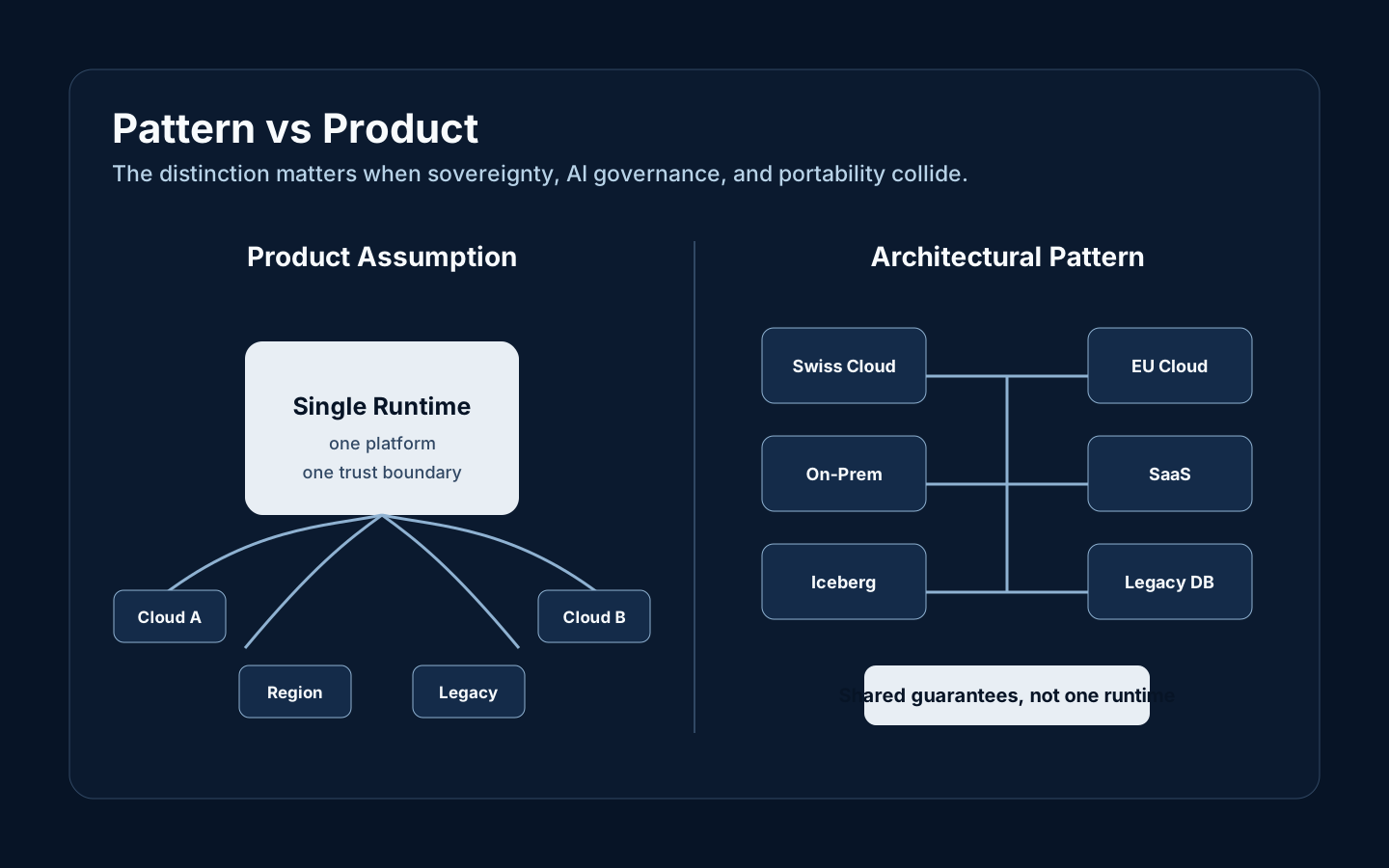
The most important misunderstanding about SDOP is assuming it is a platform. It is not.
TL;DR
- SDOP is not a product, vendor stack, or platform category. It is an architectural pattern.
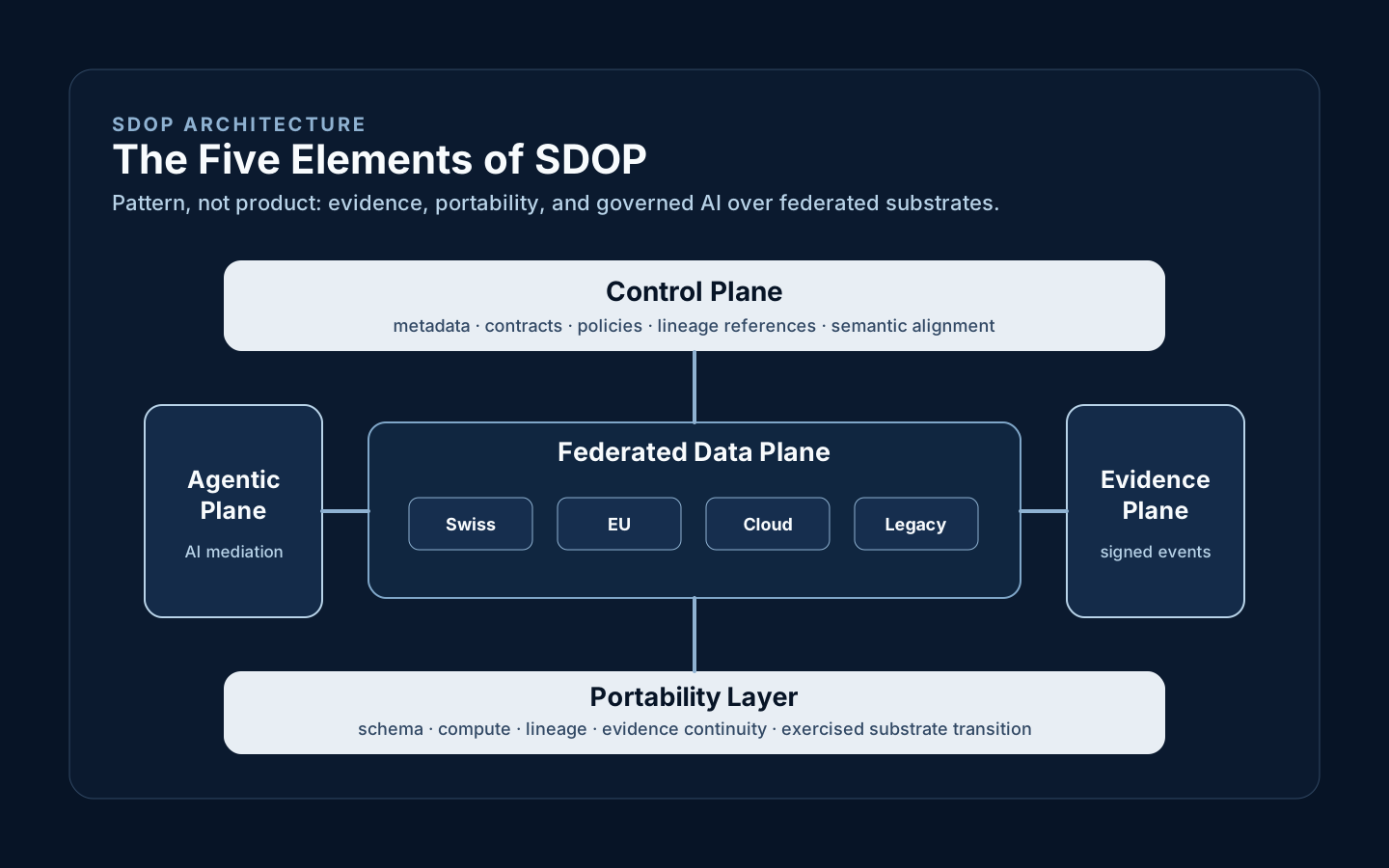
- The architecture is composed of five elements: Control Plane, Data Plane, Evidence Plane, Portability Layer, and Agentic Plane.
- Three of those elements are differentiating pillars: Evidence Plane, Portability Layer, and Agentic Plane.
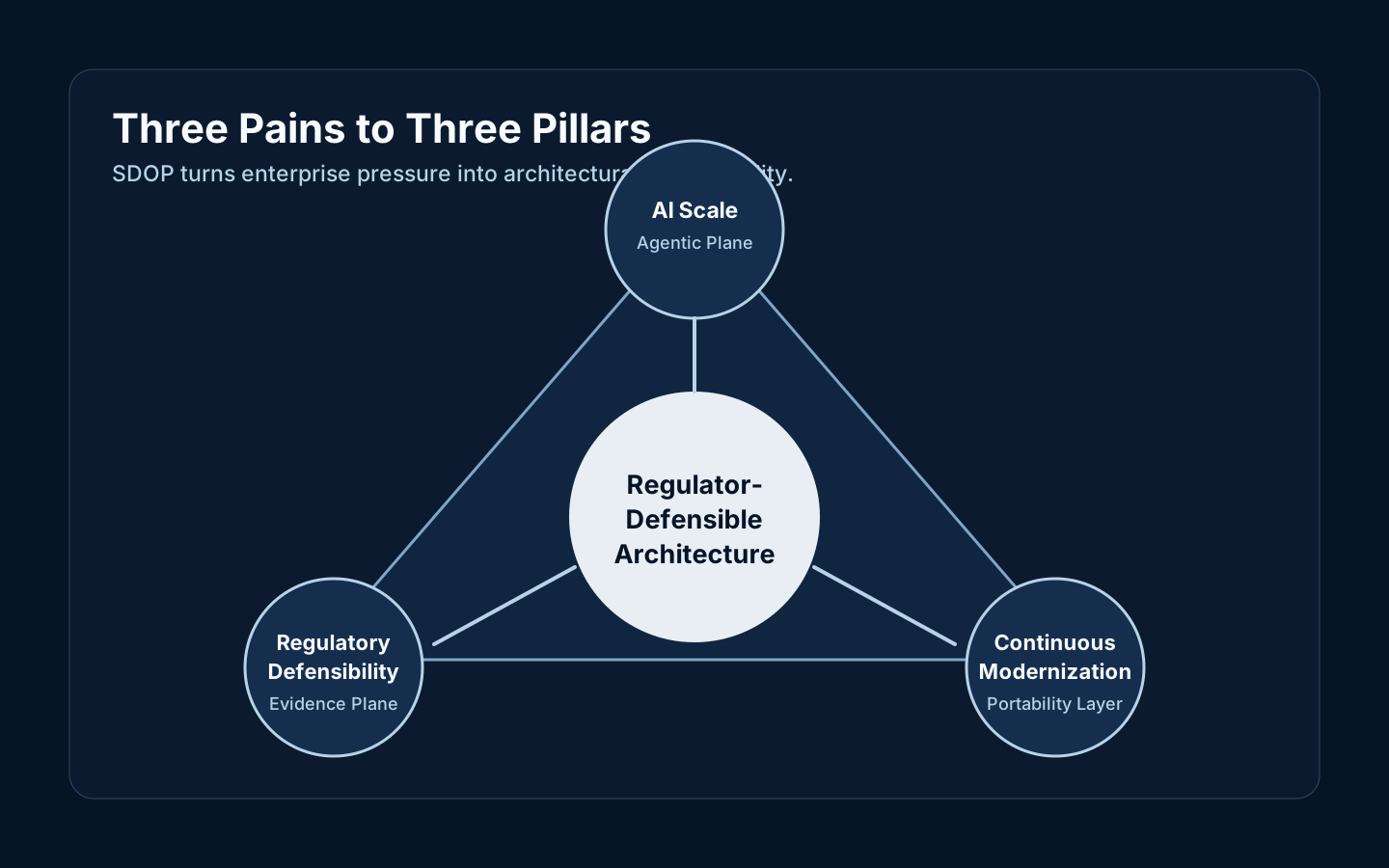
- The architecture is designed around three converging enterprise pressures: AI scale, regulator-defensibility, and continuous modernization.
- SDOP separates operational data flow from regulatory evidence production.
- The pattern is intentionally substrate-neutral: Snowflake, Databricks, Iceberg, sovereign cloud, and on-premise systems can all participate.
- The commercial importance of SDOP is precisely that it is publishable and interoperable rather than tied to a single vendor runtime.
Opening observation
One of the first reactions people have when I describe SDOP is to ask:
So is this a platform?
The question is understandable.
The enterprise data industry has spent the last decade packaging architectural ideas as platforms:
- data lakes,
- lakehouses,
- fabrics,
- meshes,
- DataOS offerings,
- AI platforms,
- governance platforms.
The assumption is now deeply embedded: if a concept matters architecturally, it must eventually collapse into a product category.
I increasingly think that assumption is becoming dangerous.
Because many of the pressures large enterprises are now dealing with - sovereign residency, regulator-defensible evidence, AI governance, continuous portability - are not solvable through a single runtime substrate.
In practice, every Tier-1 enterprise already operates:
- multiple clouds,
- multiple jurisdictions,
- multiple governance domains,
- multiple compute engines,
- and multiple generations of technology simultaneously.
The architecture is already federated whether the organization admits it or not.
That is the context SDOP emerges from.
Not as another platform attempting to centralize everything again.
But as an architectural pattern designed for the reality that centralization is no longer structurally possible in many regulated environments.
What SDOP actually is
The Sovereign Data Operating Plane - SDOP - is an architectural pattern composed of five elements.
Two of those elements are foundational substrates.
Three are differentiating pillars.
Together, they are intended to address the three pressures increasingly converging across regulated enterprises:
- enterprise AI consumption,
- regulator-defensible evidence,
- and continuous modernization.
The five elements are:
- Control Plane
- Data Plane
- Evidence Plane
- Portability Layer
- Agentic Plane
At a high level, the architecture separates:
- operational data flow,
- policy enforcement,
- regulatory evidence production,
- portability operations,
- and AI consumption mediation
into distinct but composable concerns.
That separation matters enormously.
Because most existing enterprise architectures still conflate these responsibilities inside the same runtime systems.
And that increasingly creates operational contradictions.
What SDOP is not
The distinction here is important.
SDOP is not:
- a data catalog,
- a lineage platform,
- a governance tool,
- a sovereign cloud,
- a mesh implementation,
- an AI platform,
- or a vendor coalition.
It uses some of those things.
But it is not reducible to any of them.
It is also not a methodology framework in the TOGAF sense.
And critically:
It is not a unified control plane pretending the enterprise operates inside a single trust boundary.
That assumption breaks quickly in:
- Swiss banking,
- multinational pharma,
- defense,
- post-merger environments,
- and increasingly any organization operating under serious residency obligations.
A modern regulated enterprise already contains multiple sovereign realities simultaneously.
The architecture must acknowledge that explicitly.
The two substrate elements
The first two architectural elements are necessary for the system to function, but they are not the differentiators.
They are:
- the Control Plane,
- and the Data Plane.
The Control Plane
The Control Plane carries information about data rather than the data itself.
At a practical level, it contains:
- metadata,
- contracts,
- policies,
- semantic mappings,
- orchestration signals,
- lineage references,
- and AI discovery records.
The important point is not the existence of metadata. Every architecture already has metadata somewhere.
The important point is that:
- contracts become explicit,
- policy becomes executable,
- and governance becomes machine-addressable.
A useful mental model is:
The Control Plane describes the enterprise data estate continuously.
Not periodically.
Not through PowerPoint.
Not through quarterly governance exercises.
Continuously.
The Data Plane
The Data Plane is where the actual operational data lives.
Critically: the Data Plane is plural.
A regulated enterprise may already operate:
- Swiss-restricted environments,
- EU residency environments,
- US environments,
- sovereign cloud partitions,
- confidential compute enclaves,
- and legacy systems simultaneously.
SDOP assumes this plurality is permanent.
The architecture therefore does not attempt to eliminate substrate diversity.
Instead: it standardizes the way those environments describe themselves, govern themselves, and exchange evidence.
That distinction is central.
Because the industry has repeatedly underestimated how persistent enterprise heterogeneity actually is.
The three pillars
The differentiating part of SDOP is not the substrate.
The differentiating part is the three pillars layered above it.
These are:
- The Evidence Plane
- The Portability Layer
- The Agentic Plane
Each maps directly to one of the three architectural pressures described in the previous article.
Pillar one: The Evidence Plane
The Evidence Plane exists because operational logs are not regulator-defensible evidence.
That distinction sounds subtle.
Operationally, it is enormous.
Most enterprise audit infrastructure today was designed for:
- debugging,
- incident analysis,
- operational observability.
Not for:
- long-term cryptographic verification,
- non-repudiation,
- regulator-readable lineage,
- or AI governance traceability.
The Evidence Plane separates:
- operational telemetry,
from:
- evidentiary truth.
Events become:
- signed,
- time-attested,
- policy-bound,
- and continuously verifiable.
The conceptual shift is important:
Compliance evidence stops being reconstructed manually and starts becoming a natural output of operating the architecture itself.
That is a very different operating model.
Pillar two: The Portability Layer
Most modern architectures claim portability.
Very few operationally prove it.
This is one of the reasons I increasingly describe portability as:
an operational discipline rather than a feature.
Open formats matter.
Apache Iceberg matters.
Delta interoperability matters.
But enterprises do not become portable merely because they adopted an open table format.
Real portability involves:
- schema portability,
- compute portability,
- lineage continuity,
- evidence continuity,
- migration tooling,
- and exercised failover discipline.
The key operational shift is this:
Migration is no longer an exceptional event. It is the permanent condition of large enterprises.
That means portability must become continuous.
Not aspirational.
Pillar three: The Agentic Plane
The Agentic Plane is the newest and probably least mature pillar conceptually.
It exists because AI agents are not normal consumers.
Current enterprise architectures still largely assume:
- dashboards,
- APIs,
- analysts,
- applications,
- and human request patterns.
AI agents change the behavioral model significantly.
Agents are:
- autonomous,
- composable,
- persistent,
- and increasingly capable of operating without human approval loops.
That creates entirely new architectural requirements around:
- identity,
- purpose binding,
- policy enforcement,
- retrieval governance,
- lawful basis,
- and reasoning traceability.
The Agentic Plane acts as a mediation layer between:
- AI systems,
- and the governed data estate.
Importantly: it treats AI consumption as an architectural concern rather than an application concern.
I suspect this distinction will become increasingly important over the next three to five years.
The diagram in one paragraph
At a high level, the architecture looks like this:
The Control Plane sits horizontally across the top, carrying contracts, metadata, policies, lineage, and semantic alignment.
Below it sits the federated Data Plane - multiple sovereign operational environments rather than a single runtime substrate.
To one side sits the Evidence Plane, continuously receiving signed events from every governed action across the system.
To the other side sits the Agentic Plane, mediating AI consumption and enforcing runtime policy controls.
Underneath all of them sits the Portability Layer, ensuring substrate transitions remain operationally reversible over time.
That composition is the architecture.
Not the individual technologies underneath it.
Why pattern, not product matters
This distinction matters commercially as much as technically.
If SDOP were a product, its value would depend primarily on:
- vendor adoption,
- runtime dominance,
- and platform consolidation.
That would immediately recreate the same lock-in dynamics many enterprises are already struggling with.
As a pattern, the incentives become different.
The architecture can:
- span vendors,
- survive substrate transitions,
- operate across sovereign boundaries,
- and evolve independently of any one commercial runtime.
That is strategically important.
Especially because the industry is entering a period where:
- sovereign cloud assumptions remain unresolved,
- AI governance standards are still evolving,
- portability requirements are increasing,
- and regulators are becoming more operationally demanding.
In that environment, publishable architecture patterns may become more durable than tightly coupled platform categories.
The pattern itself becomes the asset.
Not the runtime monopoly.
What I would do Monday morning
If I were introducing SDOP concepts into a large enterprise today, I would start very small.
Not with a platform rewrite.
Not with a transformation program.
I would:
- Define one explicit data product contract.
- Add one continuous evidence flow around that product.
- Test one portability exercise operationally.
- Mediate one AI use case through explicit policy enforcement.
- Separate operational logging from evidentiary records immediately.
The important thing is not deploying all five elements simultaneously.
The important thing is beginning to treat:
- evidence,
- portability,
- and AI governance
as architectural concerns rather than afterthoughts.
The tradeoff most people ignore
The biggest misconception about architectures like SDOP is assuming they simplify the enterprise.
They do not.
Large regulated enterprises are already complex.
The architecture simply stops pretending they are not.
That honesty has operational cost:
- more contracts,
- more policy infrastructure,
- more evidence generation,
- more governance friction,
- more topology awareness.
But the alternative increasingly appears worse:
- fragmented AI ecosystems,
- non-portable modernization,
- governance theater,
- and evidence reconstruction projects that never really end.
The next generation of enterprise architecture may not reduce complexity.
It may instead make complexity governable.
That is a different objective.
Closing reflection
The enterprise data industry has historically organized itself around platforms.
Increasingly, I think the next architectural cycle may organize itself around operational guarantees instead:
- provability,
- portability,
- governable AI consumption,
- and sovereign enforcement boundaries.
Those guarantees are difficult to deliver through centralized platform assumptions alone.
That is why SDOP is intentionally framed as a pattern rather than a product.
The technologies underneath it will evolve.
The clouds will evolve.
The standards will evolve.
The pressures probably will not.
And that is ultimately what the architecture is responding to.
Part of the SDOP series on regulator-defensible architecture, sovereign enterprise data systems, AI governance, and continuous modernization.
References
- BIS: Principles for effective risk data aggregation and risk reporting — BCBS 239 baseline principles for risk data aggregation and reporting.
- ECB: Guide on effective risk data aggregation and risk reporting — ECB supervisory expectations for RDARR.
- EUR-Lex: Regulation (EU) 2022/2554 on digital operational resilience — DORA regulation text.
- EUR-Lex: Regulation (EU) 2024/1689 Artificial Intelligence Act — EU AI Act official journal text.
- FINMA Circular 2023/1: Operational risks and resilience - banks — Swiss operational risk and resilience circular.
- OpenLineage documentation — Open lineage framework referenced for evidence and lineage architecture.
- SPIFFE/SPIRE documentation — Workload identity and attestation documentation.
- Open Policy Agent: Policy language — OPA/Rego policy language documentation.
- Apache Iceberg table specification — Open table format specification referenced in the portability discussion.
- Open Data Product Specification — Linux Foundation-hosted specification work referencing open data contracts and data product interoperability.
- Linux Foundation: Agentic AI Foundation and Model Context Protocol — Agentic AI Foundation announcement referencing MCP.
Author
Géza Kuti is a senior Data and AI executive based in Bülach (ZH), Switzerland, focused on data strategy, enterprise architecture, AI governance, hybrid cloud, and regulated delivery.
Related articles
When the Model Became a Critical Dependency
The Fable 5 shutdown showed that frontier models can become externally controlled dependencies for regulated enterprises. That changes how firms should think about sovereignty, portability, concentration risk, and operational resilience.
AI Is Global. Government Data Is Not
Frontier AI models are global, but government and regulated data remain jurisdictional. This article explains why sovereign AI is becoming the default architecture across Europe.
Why Most Public Sector AI Strategies Fail During Implementation
Most governments now have AI strategies, principles, and playbooks. The harder question is whether they have the delivery machinery to turn those documents into safe production systems.