Regulator-Defensible Architecture
Three Pains Every Tier-1 CDO Is Failing Right Now
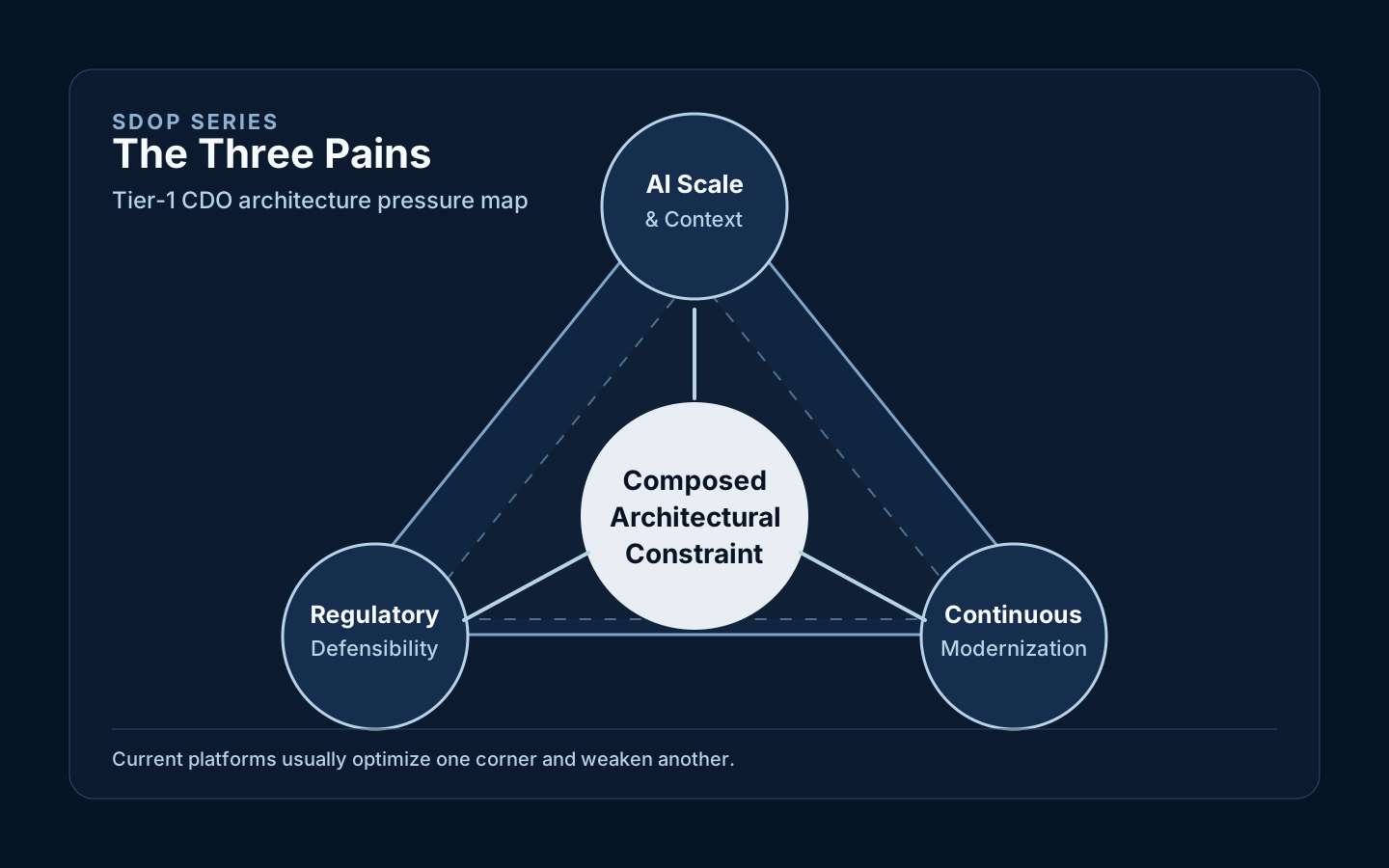
AI scale, regulator-defensibility, and continuous modernization are colliding into a single architectural problem.
Answer summary
Tier-1 enterprises are failing at enterprise AI scaling, regulator-defensible evidence production, and continuous modernization because current architectures still treat these as separate problems instead of one composed architectural constraint.
Key takeaways
- Enterprise AI is blocked primarily at the data layer.
- Regulatory evidence requirements now exceed most legacy architectures.
- Migration has become the steady state.
- Portability is an operational discipline, not a feature.
- The next architectural category must solve all three pressures simultaneously.
TL;DR
- Most Tier-1 enterprises in 2026 are simultaneously struggling with three pressures: enterprise AI scale, regulator-defensible evidence, and permanent modernization.
- Current architectures typically solve one of these pressures while worsening the others.
- Enterprise AI is increasingly blocked not by models, but by fragmented and poorly governed data access patterns.
- Regulators are no longer asking for governance intent. They are asking for operational evidence.
- Migration is no longer a temporary project. It has become the permanent operating condition of large enterprises.
- Open formats alone do not create portability. Portability is an operational discipline.
- The next generation of enterprise data architecture will likely be defined by how these three pressures are composed together.
Opening observation
A few months ago, I was sitting in a meeting with architects and platform leaders at a large European financial institution. The discussion started, as many discussions do in 2026, with AI.
The executive question was straightforward:
Where is our enterprise GenAI?
For the first fifteen minutes, the answers sounded familiar. More GPUs. Better copilots. New retrieval pipelines. More vector infrastructure. Additional governance reviews.
Then the conversation drifted into data access.
Nobody in the room could confidently answer three simple questions simultaneously:
- Which datasets were already feeding AI systems.
- Under what authority those datasets were being consumed.
- Whether the organization could still prove lineage and policy enforcement after the next major platform migration.
The mood in the room changed noticeably at that point.
What initially looked like an AI discussion slowly revealed itself as something else entirely: an architectural problem created by the collision of three pressures that most enterprises still treat separately.
That pattern has repeated itself often enough now that I no longer think of these as independent issues.
I increasingly think of them as the defining architectural constraint of the next decade.
The real problem
Most Tier-1 enterprises are currently failing three tests at the same time.
They cannot:
- Scale enterprise AI safely.
- Produce regulator-defensible evidence consistently.
- Modernize their data estate fast enough without creating new lock-in.
The important point is not that these problems exist individually. Large enterprises have always struggled with complexity.
The important point is that the three pressures now compose.
And the architectures most organizations built over the last decade were not designed for that composition.
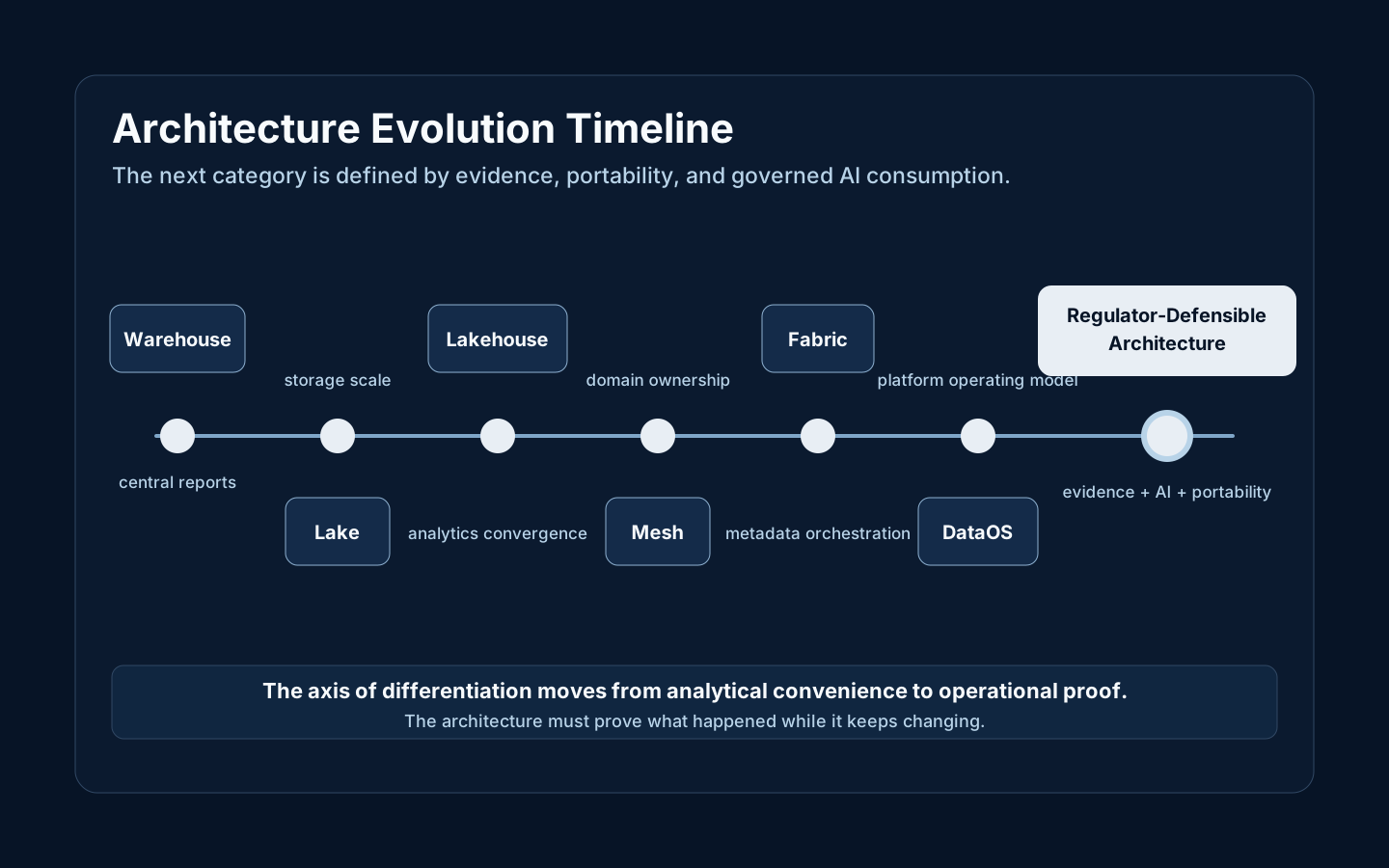
The warehouse generation optimized for centralized reporting.
The lake generation optimized for scale.
The lakehouse generation optimized for analytical convergence.
Data mesh optimized for organizational ownership.
Data fabric optimized for metadata orchestration.
All of these solved real problems.
But almost none of them were designed around regulator-defensible evidence production under permanent modernization while simultaneously supporting autonomous AI consumption.
That is a very different architectural requirement.
Pain one: enterprise AI is blocked at the data layer
The public narrative around enterprise AI still focuses heavily on models.
Inside large enterprises, that is increasingly not the real bottleneck.
The bottleneck is the data layer.
Specifically:
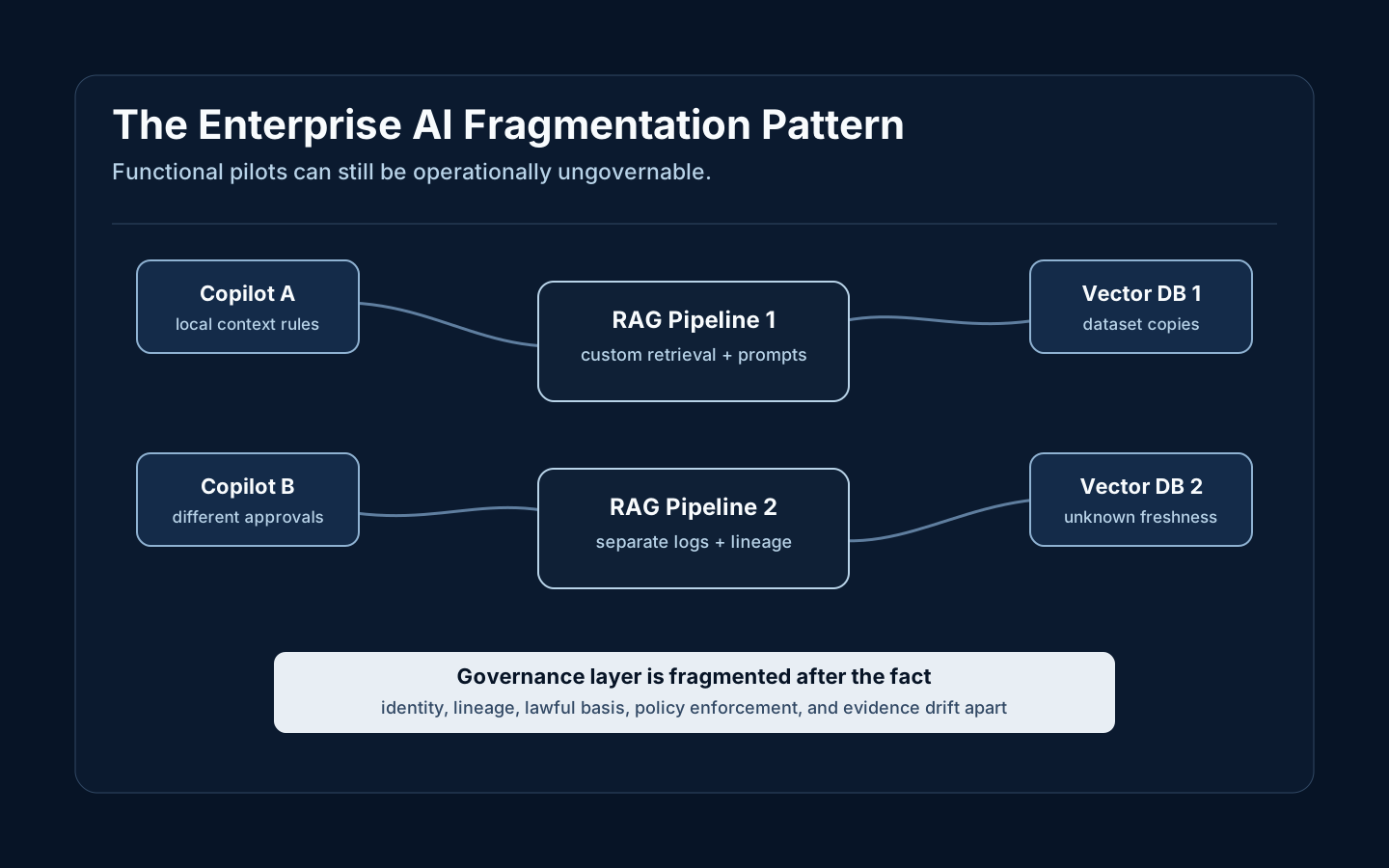
- fragmented retrieval pipelines,
- scattered vector databases,
- inconsistent identity propagation,
- weak lineage,
- unclear lawful basis,
- and governance models that assume human consumers rather than autonomous agents.
One large enterprise can easily accumulate:
- ten separate embedding services,
- multiple vector infrastructures,
- duplicated retrieval pipelines,
- and dozens of disconnected AI experiments within eighteen months.
Most of them are technically functional.
Very few are operationally governable.
That distinction matters.
Because once AI systems move beyond isolated pilots, the organization is forced to answer questions that current architectures struggle to answer reliably:
- What exactly is this model consuming?
- Which dataset version produced this output?
- Was the access policy valid at the moment of consumption?
- Can we prove downstream restrictions were respected?
- Can we reconstruct the reasoning chain later?
These are no longer theoretical governance questions.
The EU AI Act is gradually operationalizing them.
Financial regulators are beginning to operationalize them.
Internal audit functions are already operationalizing them.
And most enterprises are still running AI consumption through infrastructure patterns originally designed for dashboards and analysts.
The architecture has not caught up to the consumer.
AI agents are not just faster analysts.
They are categorically different consumers:
- autonomous,
- composable,
- persistent,
- potentially externalized,
- and capable of acting at machine speed.
That changes the required architecture substantially.
Pain two: the regulator's bar has moved
Most enterprises still think of compliance primarily as a documentation exercise.
Increasingly, regulators do not.
The shift happening quietly across BCBS 239, DORA, the EU AI Act, GxP, and operational resilience frameworks is this:
The regulator no longer wants static governance claims. The regulator wants operationally reproducible evidence.
That is a fundamentally different requirement.
A surprising amount of enterprise governance today still depends on:
- manually reconstructed lineage,
- spreadsheet-based attestations,
- PDF evidence packs,
- quarterly reconciliation exercises,
- and architecture diagrams that drift out of sync with reality almost immediately.
This worked, imperfectly, when reporting cycles were slower and architectures were more static.
It breaks under:
- federated cloud environments,
- AI consumption,
- multi-jurisdictional residency,
- and continuous modernization.
The empirical signal is already visible.
More than a decade after BCBS 239 was introduced, only a small minority of globally systemic banks are considered fully compliant by supervisory standards.
That is not because banks failed to buy enough tooling.
It is because the architecture required for continuous evidence production is materially different from the architecture optimized for analytical convenience.
The regulator's question is slowly changing from:
Do you have governance?
to:
Can you continuously prove what actually happened?
Those are not the same thing.
The difference becomes especially visible under multi-residency pressure.
A modern Tier-1 enterprise now operates across:
- sovereign cloud requirements,
- national residency obligations,
- AI governance obligations,
- portability obligations,
- and increasingly fragmented legal boundaries around data movement.
At that point, governance stops being primarily a catalog problem.
It becomes a topology problem.
Pain three: migration has become the steady state
One of the biggest architectural misconceptions of the last decade was treating modernization as a temporary phase.
It is not temporary anymore.
Migration has become the permanent operating condition of large enterprises.
At any given moment, a Tier-1 organization is likely running:
- cloud migration,
- post-merger integration,
- legacy decommissioning,
- sovereign cloud restructuring,
- AI platform expansion,
- regulatory remediation,
- and vendor rationalization simultaneously.
A few patterns now appear repeatedly across industries:
- Major banks moving thousands of Oracle workloads while still modernizing mainframes.
- Industrial enterprises shifting SAP estates while building cloud-native AI layers.
- Financial institutions integrating post-merger environments for years after legal consolidation.
- Sovereign cloud strategies forcing architectural segmentation that existing global platforms were never designed for.
The important observation is this:
Even organizations using open formats like Apache Iceberg or Delta often remain deeply operationally locked-in.
Because portability is not only about storage formats.
It is about:
- compute portability,
- lineage continuity,
- schema migration,
- policy portability,
- evidence preservation,
- and operational testing discipline.
I have seen multiple enterprises confidently describe themselves as portable while having never exercised a meaningful failover or substrate transition under production conditions.
That is not portability.
That is optimism.
Increasingly, regulators seem to understand this distinction as well.
DORA's operational logic moves in this direction very clearly.
An exit plan that has never been exercised is not operationally credible.
And once portability becomes a regulatory concern rather than a technical preference, the architecture changes again.
Why these three pains compose
This is the critical point.
Most organizations still attempt to solve these pressures independently.
That increasingly makes the situation worse.
Examples:
An enterprise accelerates AI adoption quickly.
Result:
- governance gaps widen,
- evidence quality deteriorates,
- regulatory exposure increases.
An organization centralizes governance aggressively.
Result:
- modernization velocity slows,
- AI experimentation fragments outside governance,
- platform teams become bottlenecks.
A firm prioritizes rapid modernization.
Result:
- lineage ruptures,
- portability assumptions fail,
- evidence continuity breaks during migration.
The three pressures are now tightly coupled.
Solving one while ignoring the others creates architectural instability.
This is why so many transformation programs now feel simultaneously expensive, incomplete, and exhausting.
The organization is trying to solve a compositional problem with isolated architectural patterns.
The architectural implication
I increasingly believe the next architectural category will not be defined primarily by:
- storage,
- compute,
- metadata,
- or orchestration.
It will be defined by whether it can simultaneously support:
- governed AI consumption,
- regulator-defensible evidence production,
- and continuous modernization.
That likely requires three architectural capabilities becoming first-class concerns:
- An evidence-producing architecture rather than periodic evidence reconstruction.
- Operational portability rather than theoretical portability.
- A dedicated mediation layer for autonomous AI consumption.
The important shift is conceptual.
The compliance project becomes a query.
The portability claim becomes an exercised operational discipline.
The AI governance model becomes part of runtime architecture rather than policy documentation.
That is a different way of thinking about enterprise data architecture.
And it may ultimately matter more than the next warehouse, lakehouse, or metadata abstraction cycle.
What I would do Monday morning
If I were a Tier-1 CDO today, I would do five things immediately.
- Inventory which datasets are already feeding AI systems, not theoretically, but operationally.
- Identify where lineage still depends on manual reconstruction.
- Run one real portability simulation this quarter, even on a small scope.
- Force every new AI use case to declare lawful basis and downstream restrictions explicitly.
- Stop treating governance, AI, and modernization as separate programs.
Most enterprises already have the technology required to begin.
What they usually lack is a coherent architectural framing that composes the pressures together.
The tradeoff most people ignore
Architectures capable of producing regulator-defensible evidence continuously are operationally heavier.
There is no honest way around this.
Evidence generation, policy enforcement, portability testing, sovereign segmentation, and AI mediation all introduce friction and cost.
The operational overhead is real.
So is the organizational complexity.
But the alternative increasingly appears worse:
- permanent remediation cycles,
- uncontrolled AI proliferation,
- migration deadlock,
- and growing regulator distrust in enterprise data governance claims.
The next decade's winning architectures are unlikely to be the lightest architectures.
They are more likely to be the architectures that make complexity governable.
Closing reflection
The enterprise data industry spent the last decade optimizing for scale and analytical convergence.
The next decade appears likely to optimize for something else:
- evidence,
- sovereignty,
- governable AI consumption,
- and reversible modernization.
That is a different architectural era.
The important question is no longer whether enterprises will modernize.
They are already modernizing continuously.
The important question is whether they can still prove what happened while doing it.
Because increasingly, that is the bar regulators, boards, and AI governance functions are converging toward simultaneously.
And most current architectures were not designed for that world.
Part of the ongoing SDOP series on regulator-defensible data architecture, sovereign data systems, enterprise AI governance, and continuous modernization.
References
- BIS: Principles for effective risk data aggregation and risk reporting — BCBS 239 baseline principles for risk data aggregation and reporting.
- BIS: Progress in adopting the BCBS 239 principles — Basel Committee progress reporting on implementation gaps.
- ECB: Guide on effective risk data aggregation and risk reporting — ECB supervisory expectations for RDARR.
- EUR-Lex: Regulation (EU) 2022/2554 on digital operational resilience — DORA regulation text.
- EUR-Lex: Regulation (EU) 2024/1689 Artificial Intelligence Act — EU AI Act official journal text.
- FINMA Circular 2023/1: Operational risks and resilience - banks — Swiss operational risk and resilience circular.
- Apache Iceberg table specification — Open table format specification referenced in the portability discussion.
- OpenLineage documentation — Open lineage framework referenced for evidence and lineage architecture.
- SPIFFE/SPIRE documentation — Workload identity and attestation documentation.
- Linux Foundation: Agentic AI Foundation and Model Context Protocol — Agentic AI Foundation announcement referencing MCP.
Author
Géza Kuti is a senior Data and AI executive based in Bülach (ZH), Switzerland, focused on data strategy, enterprise architecture, AI governance, hybrid cloud, and regulated delivery.
Related articles
When the Model Became a Critical Dependency
The Fable 5 shutdown showed that frontier models can become externally controlled dependencies for regulated enterprises. That changes how firms should think about sovereignty, portability, concentration risk, and operational resilience.
AI Is Global. Government Data Is Not
Frontier AI models are global, but government and regulated data remain jurisdictional. This article explains why sovereign AI is becoming the default architecture across Europe.
Why Most Public Sector AI Strategies Fail During Implementation
Most governments now have AI strategies, principles, and playbooks. The harder question is whether they have the delivery machinery to turn those documents into safe production systems.