Regulator-Defensible Architecture
Eleven Years, Two Banks: An Empirical Post-Mortem on BCBS 239
What the industry's most important compliance statistic reveals about modern enterprise data architecture.
Answer summary
The Basel Committee's 2023 BCBS 239 progress report found that only two of 31 assessed G-SIBs were fully compliant with all Principles. That outcome is an architectural signal: the last decade optimized for scale, flexibility, ownership, metadata, and cloud convergence more than continuous regulator-defensible evidence production.
Key takeaways
- Only a small minority of G-SIBs are fully BCBS 239 compliant.
- Most architectural waves optimized for the wrong constraints.
- Lineage and evidence remain operationally unresolved.
- Compliance increasingly depends on continuous evidence production.
- The next architectural generation must treat evidence as infrastructure.
The most important number in modern enterprise data architecture may be 2 of 31.
TL;DR
- More than a decade after BCBS 239 was introduced, only a very small minority of G-SIBs are considered fully compliant.
- That statistic is not primarily a governance failure. It is an architectural signal.
- Over the last decade, the industry successively optimized for scale, flexibility, decentralization, metadata automation, and cloud convergence - but rarely for regulator-defensible evidence production.
- Warehouses, lakes, lakehouses, meshes, and fabrics all solved real problems while leaving critical BCBS 239 requirements operationally unresolved.
- The hardest unresolved problems remain attribute-level lineage, evidence continuity, and cross-jurisdiction enforcement.
- The regulator's bar has shifted from periodic governance exercises toward continuously reproducible evidence.
- The next generation of enterprise architecture will likely be defined by evidence production rather than storage abstraction.
Opening observation
A few years ago, during a banking transformation workshop, an executive asked a question that initially sounded simple:
After all this investment, why is BCBS 239 still so difficult?
The room went quiet for a moment.
Not because nobody had an answer.
But because everyone had too many answers.
Some blamed organizational silos.
Others blamed legacy infrastructure.
Someone blamed acquisitions.
Someone else blamed regulators moving the goalposts.
All of those explanations contained some truth.
But I remember thinking afterward that the discussion was missing something more uncomfortable:
What if the architectures we built over the last decade were optimized for the wrong problem?
That possibility becomes harder to ignore when you look at the empirical outcome.
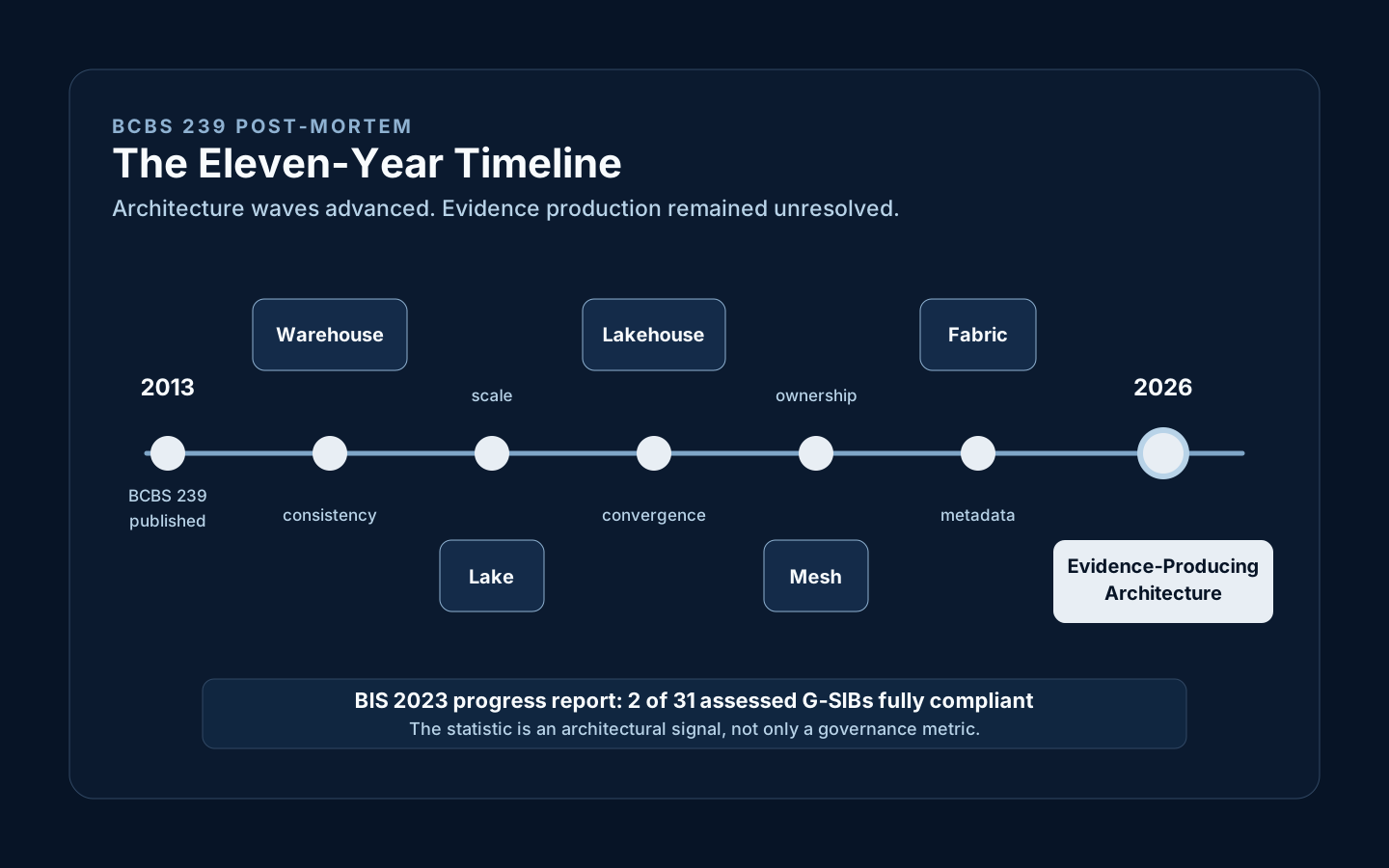
The Basel Committee's 2023 progress report, based on 31 G-SIBs assessed as of June 2022, stated that only two banks were fully compliant with all BCBS 239 Principles.
The exact number matters less than the pattern.
The pattern is that after:
- billions in transformation spending,
- cloud migrations,
- governance programs,
- lineage tooling,
- lakehouses,
- metadata platforms,
- and operating model redesigns,
the industry still struggles to produce regulator-defensible risk data consistently.
That should probably force a deeper architectural conversation than it currently does.
What BCBS 239 actually asked for
BCBS 239 was never merely a reporting exercise.
At its core, the regulation asked banks to demonstrate something much more operational:
That risk data could be aggregated accurately, traced reliably, adapted quickly, and governed consistently during stress conditions.
That sounds straightforward in PowerPoint.
Operationally, it is brutal.
Because satisfying those requirements simultaneously implies:
- lineage continuity,
- semantic consistency,
- governance accountability,
- operational traceability,
- and reproducible evidence generation
across extremely fragmented enterprise environments.
The architectural implication was always deeper than most organizations initially understood.
BCBS 239 effectively demanded enterprise-wide evidence-producing data architecture years before the industry had language for such a thing.
Most organizations instead interpreted the problem as:
- a data governance initiative,
- a reporting modernization effort,
- or a metadata management challenge.
That interpretation turned out to be incomplete.
The 2013-2026 architectural timeline
One way to understand the current situation is to look at the architectural waves that followed BCBS 239 chronologically.
What becomes striking in hindsight is not that these architectures failed.
Most solved real and important enterprise problems.
What becomes striking is that almost none optimized primarily for regulator-defensible evidence production.
The warehouse era: consistency over flexibility
In the earlier post-crisis years, many banks still relied heavily on centralized warehouse models.
These systems optimized for:
- standardization,
- controlled reporting,
- reconciliation,
- and centralized governance.
Their strengths were obvious:
- relatively stable semantics,
- constrained transformation logic,
- clearer ownership structures.
But they struggled operationally with:
- adaptability,
- latency,
- enterprise-scale heterogeneity,
- and rapidly evolving data estates.
Ironically, some warehouses were actually closer to BCBS 239 objectives structurally than many later architectures.
Not because they were modern.
But because they were constrained.
The data lake era: scale becomes the priority
As cloud economics improved, the industry shifted aggressively toward lakes.
The primary optimization target became scale.
Store everything.
Process later.
Separate storage from compute.
This solved important problems:
- ingestion bottlenecks,
- storage cost,
- unstructured data support,
- analytical flexibility.
But it introduced a different failure mode.
The lake model implicitly optimized for:
analytical possibility rather than evidentiary certainty.
Lineage became fragmented.
Schemas drifted.
Governance became increasingly retrospective.
The industry gained scale.
But often lost traceability.
The lakehouse era: analytical convergence
The lakehouse wave attempted to reconcile warehouse reliability with lake flexibility.
And in many ways, it succeeded technically.
Open table formats.
ACID transactions.
Improved metadata layers.
Unified analytics.
Again: real progress.
But the optimization target remained largely analytical convergence rather than regulator-defensible evidence.
This distinction matters enormously.
A lakehouse can:
- process petabytes efficiently,
- support machine learning,
- expose real-time analytics,
- and still fail operationally at:
- attribute-level lineage,
- evidence continuity,
- lawful-basis reconstruction,
- or reproducible historical policy evaluation.
The industry solved data processing very effectively.
It did not fully solve evidentiary reconstruction.
The mesh era: organizational reality arrives
Data mesh introduced something the earlier generations underestimated: organizational structure.
Domain ownership.
Federated governance.
Data as a product.
In many enterprises, this was a necessary correction.
Because centralized governance teams were already collapsing under scale and organizational complexity.
Mesh solved an important political and operational problem:
- ownership became explicit.
But architecturally, mesh often inherited an assumption that becomes difficult under serious regulatory pressure:
- a relatively coherent trust boundary.
In highly regulated multinational environments, that assumption breaks quickly.
Because sovereignty, residency, and evidence continuity become cross-domain concerns that cannot be delegated entirely to local ownership models.
Mesh improved organizational alignment substantially.
It did not fully solve evidentiary topology.
The fabric era: metadata everywhere
The fabric wave recognized another important reality:
- the enterprise was already fragmented,
- therefore orchestration and metadata had to become smarter.
This drove:
- active metadata,
- automated lineage,
- semantic mapping,
- governance automation.
Again: important progress.
But the optimization target remained primarily:
- orchestration,
- discovery,
- automation.
Not:
- cryptographically verifiable evidence,
- non-repudiation,
- or continuously reproducible supervisory artifacts.
Metadata automation helped visibility.
It did not fully solve provability.
What all these waves optimized for instead
Looking backward, the architectural sequence becomes clearer.
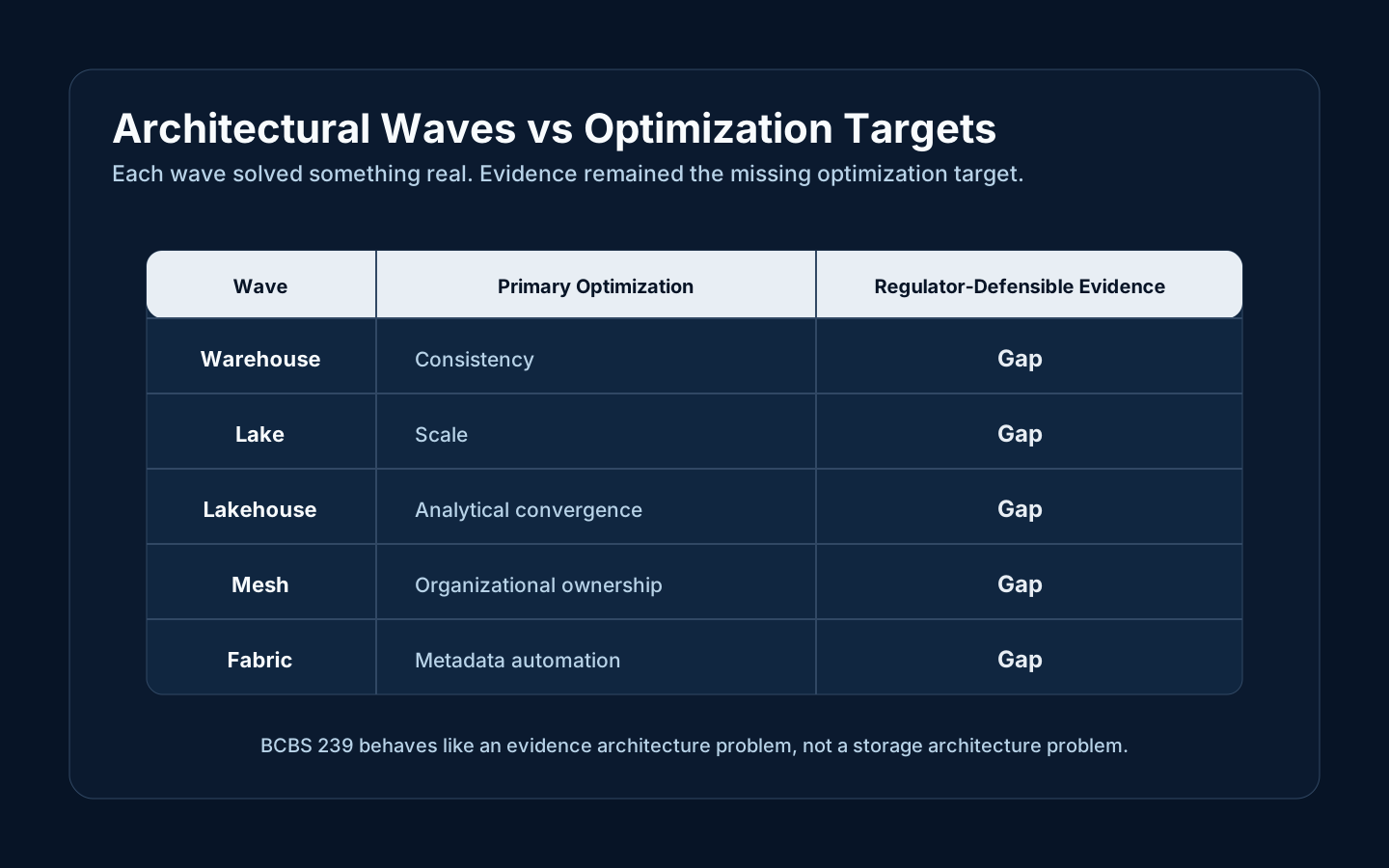
Each generation optimized for a different primary constraint:
| Architectural wave | Primary optimization |
|---|---|
| Warehouse | Consistency |
| Lake | Scale |
| Lakehouse | Analytical convergence |
| Mesh | Organizational ownership |
| Fabric | Metadata automation |
The missing optimization target across almost all generations was:
regulator-defensible evidence production.
That distinction matters because BCBS 239 increasingly behaves like an evidence architecture problem rather than a storage architecture problem.
The three requirements that still break most architectures
Three requirements continue to expose structural weaknesses repeatedly.
1. Attribute-level lineage
Table lineage is difficult.
Attribute-level lineage at enterprise scale is exponentially harder.
Especially across:
- heterogeneous compute engines,
- cloud boundaries,
- legacy systems,
- and federated transformation pipelines.
Most organizations still rely heavily on:
- partial reconstruction,
- manual enrichment,
- or inference.
The regulator increasingly expects reproducibility.
That is a much higher bar.
2. Signed, verifiable evidence
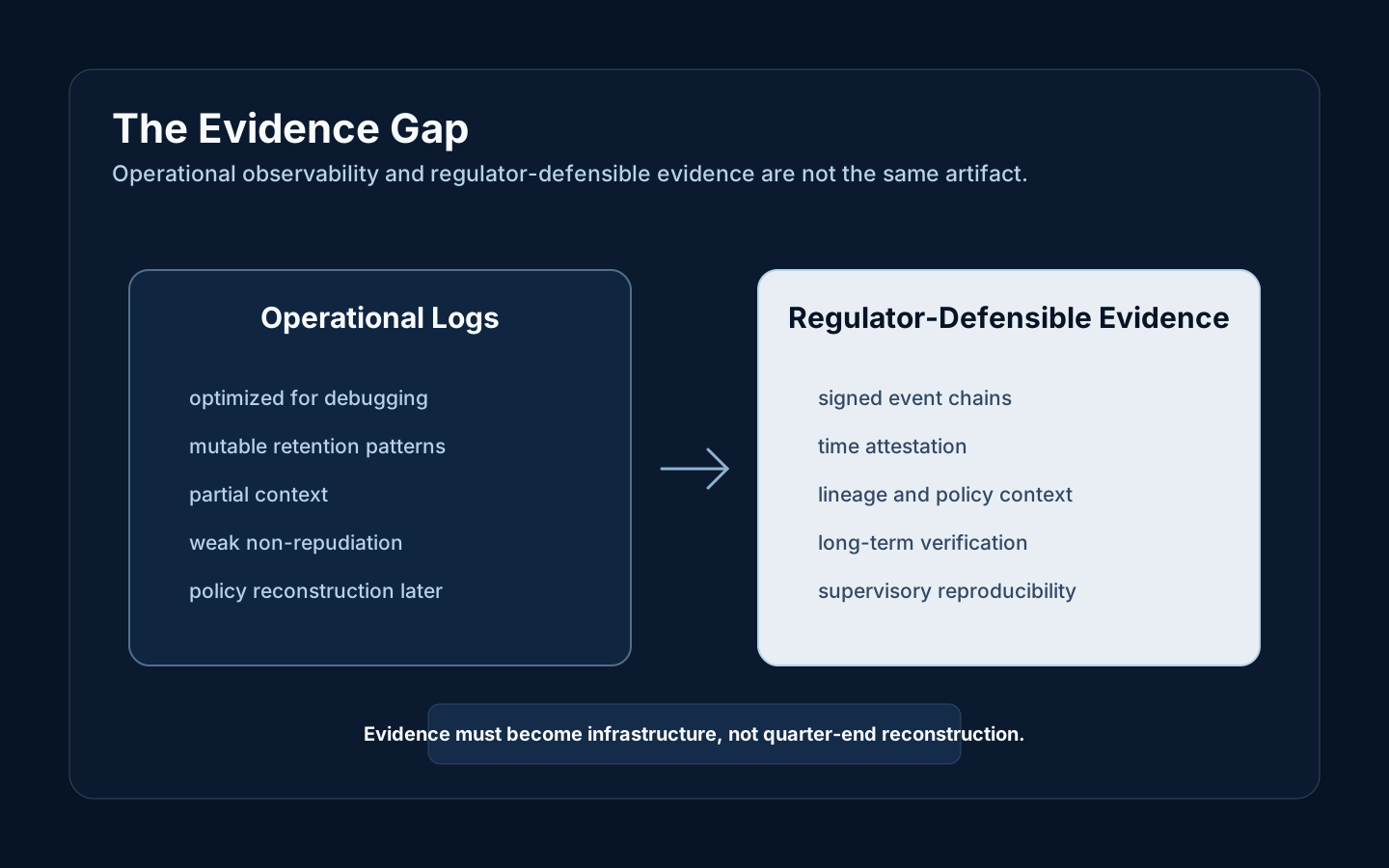
Operational logs are not the same thing as regulator-defensible evidence.
This distinction remains underappreciated.
Logs are:
- mutable operational artifacts,
- optimized for debugging and observability.
Regulatory evidence increasingly requires:
- immutability,
- time attestation,
- policy traceability,
- and long-term verifiability.
Most architectures still treat evidence as documentation.
Not as infrastructure.
3. Multi-jurisdiction enforcement
Modern Tier-1 banks no longer operate inside single legal topologies.
They operate across:
- sovereign cloud requirements,
- residency obligations,
- AI governance restrictions,
- and cross-border operational constraints simultaneously.
Most architectures were originally designed assuming relatively unified operational trust zones.
That assumption no longer holds consistently.
Governance increasingly becomes:
- topology-aware,
- residency-aware,
- and jurisdiction-aware.
That is a substantially harder architectural problem.
What this implies about the next architectural pattern
I increasingly think the industry has been asking the wrong question.
The question was never:
What is the next storage abstraction?
The more important question may be:
How does the enterprise continuously produce defensible evidence while remaining portable and AI-capable?
That is a different architectural premise entirely.
It shifts the optimization target from:
- storage,
- compute,
- and orchestration,
toward:
- evidence,
- portability,
- and governed consumption.
The implication is subtle but important.
The compliance project itself begins to change shape.
Instead of:
- periodic reconstruction,
- manual evidence assembly,
- and retrospective governance,
the architecture starts producing evidence continuously as a natural output of operation.
In other words:
The compliance project becomes a query.
And once you see the problem through that lens, many current architectural assumptions start looking incomplete.
That is the same architectural direction explored in the Sovereign Data Operating Plane pattern.
What I would do Monday morning
If I were leading a Tier-1 BCBS 239 remediation effort today, I would focus less on dashboards and more on evidence flows.
Specifically:
- Identify where lineage still depends on human reconstruction.
- Separate operational observability from regulatory evidence explicitly.
- Map which datasets already cross sovereign or residency boundaries.
- Test whether portability exercises preserve lineage continuity.
- Treat AI consumption as part of BCBS 239 scope immediately rather than later.
Most organizations already have enough tooling.
What they usually lack is an architecture optimized for the actual supervisory requirement.
The tradeoff most people ignore
Architectures optimized for evidence production are operationally heavier.
That is unavoidable.
Continuous evidence generation introduces:
- cost,
- latency,
- governance friction,
- and operational discipline requirements.
But the alternative increasingly appears worse:
- endless remediation cycles,
- fragmented governance,
- inconsistent lineage,
- and growing supervisory distrust.
The industry already spent more than a decade trying lighter-weight approaches.
The results are visible.
Closing reflection
The most important signal in enterprise data architecture may not be the rise of AI.
It may not be lakehouses.
It may not be sovereign cloud.
It may simply be this:
After more than a decade of investment, the industry still struggles to produce regulator-defensible evidence consistently.
That should probably force a deeper reassessment of what enterprise data architecture is actually optimizing for.
Because if the next decade repeats the last decade, the industry will likely continue accumulating:
- more platforms,
- more metadata,
- more governance tooling,
- more AI infrastructure,
while still reconstructing compliance manually at quarter-end.
At some point, the architecture itself has to change.
Not because regulators demanded new paperwork.
But because the operational assumptions underneath the previous generation were never really designed for evidentiary continuity in the first place.
Part of the SDOP series on regulator-defensible architecture, sovereign data systems, enterprise AI governance, and continuous modernization.
References
- BIS: Principles for effective risk data aggregation and risk reporting — Original BCBS 239 principles.
- BIS: Progress in adopting the BCBS 239 principles — Basel Committee 2023 progress report assessing 31 G-SIBs.
- ECB: Guide on effective risk data aggregation and risk reporting — ECB supervisory expectations for RDARR.
- FINMA Circular 2023/1: Operational risks and resilience - banks — Swiss operational risk and resilience circular.
- EUR-Lex: Regulation (EU) 2022/2554 on digital operational resilience — DORA regulation text.
- EUR-Lex: Regulation (EU) 2024/1689 Artificial Intelligence Act — EU AI Act official journal text.
- OpenLineage documentation — Open lineage framework referenced for lineage architecture.
- Apache Iceberg table specification — Open table format specification referenced in modern architecture discussion.
Author
Géza Kuti is a senior Data and AI executive based in Bülach (ZH), Switzerland, focused on data strategy, enterprise architecture, AI governance, hybrid cloud, and regulated delivery.
Related articles
When the Model Became a Critical Dependency
The Fable 5 shutdown showed that frontier models can become externally controlled dependencies for regulated enterprises. That changes how firms should think about sovereignty, portability, concentration risk, and operational resilience.
AI Is Global. Government Data Is Not
Frontier AI models are global, but government and regulated data remain jurisdictional. This article explains why sovereign AI is becoming the default architecture across Europe.
Why Most Public Sector AI Strategies Fail During Implementation
Most governments now have AI strategies, principles, and playbooks. The harder question is whether they have the delivery machinery to turn those documents into safe production systems.